


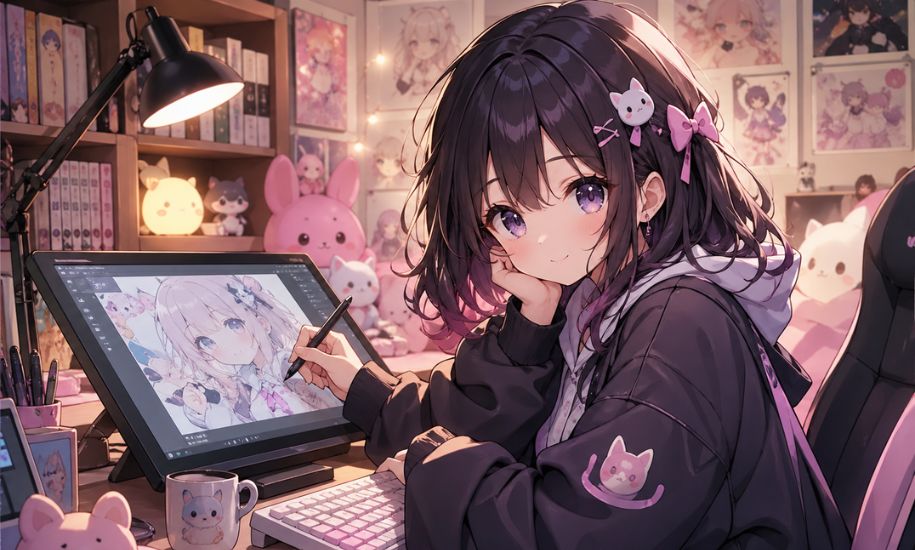
If you’ve recently searched for “dojen moe,” you may have noticed something unusual: different websites seem to explain it in completely different ways. Some describe it as an anime-inspired creative style, others connect it with fan art and emotional character design, while some suggest that “dojen” is simply a variation of doujin.
That inconsistency is important.
Unlike established Japanese pop-culture terms such as doujin, doujinshi, and moe, “dojen moe” does not appear to have one universally accepted definition or status as an official anime genre. Current online discussions largely treat it as an ambiguous internet phrase that may combine ideas associated with independent fan creation and moe-style character appeal.
So, rather than presenting dojen moe as a formally recognised Japanese movement, it is more accurate to examine where the words come from, how people use the phrase today, and why it has become increasingly visible in search results.
What Does “Dojen Moe” Mean?
The simplest answer is that “dojen moe” is an ambiguous internet expression rather than a clearly established Japanese cultural term.
The phrase appears to draw on two genuine concepts:
- Doujin (同人): independent or self-published creative activity associated with people sharing an interest.
- Moe (萌え): a Japanese fandom term describing a strong feeling of affection, fascination, or emotional attachment toward fictional characters or particular character traits.
Doujin is a well-established part of Japanese fan and independent creative culture, while moe has its own history within anime, manga, and game fandom.
The spelling “dojen” is where the confusion begins. The standard romanisations commonly encountered for 同人 are doujin, dōjin, or sometimes dojin, rather than “dojen.” This makes it risky to describe “dojen moe” as an old Japanese term with a precise historical definition.
A useful interpretation is therefore:
Dojen moe is an internet search phrase that is often associated with doujin-style independent creativity and the emotional appeal of moe, but it is not a standard name for an established Japanese genre.
That distinction makes the subject much easier to understand.
Doujin: The Concept Behind the Spelling Confusion
To understand why people connect “dojen” with Japanese fandom, it helps to understand doujin.
The Japanese word 同人 broadly relates to people who share an interest, purpose, or affiliation. In contemporary pop culture, doujin is commonly associated with independent creative communities producing works outside conventional commercial publishing.
Those works can include:
- Manga
- Novels
- Illustrations
- Music
- Games
- Art books
- Other fan or independently produced media
A related term, doujinshi, traditionally refers to self-published publications, particularly manga, magazines, and novels. Doujinshi can contain original stories as well as derivative works inspired by existing anime, manga, games, or other media.
This is an important correction to a common misconception: doujin does not automatically mean adult content.
Some doujin works are adult-oriented, but the broader doujin ecosystem is much larger. It includes original creative projects, parody, fan fiction, music, games, criticism, art, and many other forms of independent expression.
What Is Moe?
The second half of the phrase, moe, has a much clearer cultural history.
Written as 萌え, moe is a Japanese fandom expression describing a strong emotional response to fictional characters, settings, traits, or situations. Depending on context, it can involve affection, excitement, fascination, tenderness, or a desire to support or protect a character.
This is why translating moe simply as “cute” can be misleading.
Something can be cute without producing a moe response. Moe is more about the emotional reaction generated by particular character qualities.
For example, fans might experience moe toward a character because of:
- A gentle personality
- Shyness
- A distinctive voice
- A vulnerable moment
- A particular character archetype
- An unusual hobby
- A combination of contrasting personality traits
In other words, moe describes a relationship between the audience and the character, not merely the visual appearance of the character.
Is “Dojen Moe” a Real Japanese Term?
This is probably the most important question surrounding the keyword.
There is no strong evidence that “dojen moe” is a standard Japanese term or a formally recognised anime genre.
Recent English-language pages discussing the phrase frequently acknowledge that its meaning is inconsistent. Some interpret it as a combination of doujin and moe, while others suggest it may be a misspelling, search variation, or internet-created expression.
That doesn’t make the phrase meaningless.
Internet language frequently develops through repetition. A spelling variation can appear in searches, social posts, blogs, usernames, or content titles. Once enough pages begin using the same expression, the phrase itself can become searchable even when it wasn’t originally a recognised cultural category.
This appears to be an important part of the story behind dojen moe.
Dojen Moe vs Doujin vs Moe
These terms should not be treated as interchangeable.
| Term | Meaning | Cultural status |
|---|---|---|
| Doujin | Independent/fan-oriented creative activity and communities | Established Japanese term |
| Doujinshi | Self-published publications, especially manga and related works | Established term |
| Moe | Emotional affection or fascination toward fictional characters/traits | Established fandom term |
| Dojen Moe | Ambiguous phrase associated online with doujin + moe | No single accepted definition |
This distinction prevents one of the biggest problems in articles about the subject: taking two genuine Japanese concepts and assuming that their combination automatically represents an established genre.
It doesn’t.
Why Is “Dojen Moe” Appearing More Often Online?
The recent visibility of the phrase appears to be driven largely by the way internet culture and search behaviour interact.
Several factors can contribute to this.
Search Variations
People don’t always remember unfamiliar Japanese words accurately.
Someone who encounters “doujin moe” may later search:
- Dojen moe
- Doujen moe
- Doujin moe
- Dojin moe
- Dojen anime
- Doujen manga
These variations can eventually become topics of their own.
SEO Content
The phrase has also generated numerous explanatory articles during 2025 and 2026. Several current pages explicitly discuss the uncertainty surrounding its meaning.
This creates a feedback loop:
- Someone searches for an unfamiliar phrase.
- A website publishes an explanation.
- Search engines index the page.
- More people encounter the phrase.
- Additional websites publish their own explanations.
- The phrase becomes increasingly visible.
As a result, search popularity does not necessarily prove that a term has a long-established cultural history.
That’s a particularly useful lesson when researching emerging internet terminology.
How Doujin Culture Actually Works
Doujin culture is much broader than the phrase dojen moe suggests.
One of its defining features is the ability of individuals and small creative groups to produce and distribute their own work.
A creator doesn’t necessarily need a major publisher or studio to participate.
They can develop a project independently and distribute it through:
- Fan conventions
- Specialist shops
- Digital marketplaces
- Online communities
- Personal websites
- Social platforms
Academic research describes dōjin as encompassing fan works across multiple media, including games, music, comics, and other creative formats. Doujinshi specifically refers to the publication side of that broader ecosystem.
This independence is one reason doujin culture has had such a lasting influence on Japanese fandom.
How Moe Influences Character Design
Moe is not simply about drawing a character with large eyes or pastel colours.
Although certain visual styles can be associated with moe-oriented media, the emotional response is more important than any single visual formula.
A character might be considered appealing because of:
- Personality
- Behaviour
- Vulnerability
- Kindness
- Social awkwardness
- Enthusiasm
- A specific relationship dynamic
- Small recurring habits
This explains why two characters can have completely different visual designs while both producing a moe response.
Moe is therefore better understood as an emotional and cultural concept rather than a fixed art style.
Does Moe Mean “Cute”?
Not exactly.
“Cute” is probably the easiest English approximation, but it doesn’t capture the entire idea.
Consider the difference:
Cute:
“This character has an adorable design.”
Moe:
“I feel a strong emotional attachment to this character because of the qualities the character represents.”
The second statement is much closer to the fandom meaning of moe.
This distinction is one of the reasons the term is difficult to translate directly.
Is Dojen Moe an Anime Genre?
No—not in any established classification sense.
There are recognised anime and manga categories, genres, publishing formats, and fandom terms. “Dojen moe” does not have the same established status.
Some online articles use it as if it describes a particular style of fan-created anime art or emotional storytelling. That interpretation can be useful as an informal description, but it should not be presented as an official genre classification.
A more accurate phrase would be:
“Some online communities use dojen moe informally to describe content associated with independent fan creativity and moe aesthetics.”
That wording separates online usage from established Japanese terminology.
Is Doujinshi the Same as Dojen Moe?
No.
Doujinshi is an established term for self-published works, particularly publications such as manga and novels. It can include both original creations and works based on existing intellectual properties.
“Dojen moe,” by contrast, has no comparable fixed definition.
You could encounter a doujinshi containing moe-oriented characters, but that does not mean every doujinshi is “dojen moe.”
Likewise, a moe-oriented work does not automatically qualify as doujinshi.
The terms describe different dimensions of fandom.
A Less Obvious Insight: Doujin Is Not Necessarily Amateur
Another misconception is that independent automatically means low quality.
That’s not necessarily true.
Doujin creators can be hobbyists, emerging artists, experienced professionals, or people working somewhere between those categories. Some creators use independent publishing as a way to experiment without the constraints of mainstream commercial production.
This makes doujin culture particularly interesting from a creative perspective.
The important distinction is independence of production, not simply the creator’s skill level.
Another Important Insight: Internet Definitions Can Become Self-Reinforcing
One of the most interesting things about dojen moe is that the search ecosystem itself may be helping create its modern meaning.
When dozens of articles repeat the same explanation, readers naturally assume that the definition must have existed beforehand.
But online terminology doesn’t always work that way.
A phrase can evolve like this:
misspelling → search query → blog topic → repeated definition → perceived cultural term
That doesn’t mean the phrase has no value. It means researchers should distinguish between documented cultural history and recent internet interpretation.
This is especially important when dealing with Japanese words because romanisation creates additional opportunities for spelling variation.
Why the Spelling Matters
“Dojen” is not simply an alternative spelling that can automatically be treated as equivalent to “doujin.”
The commonly recognised Japanese term 同人 is generally romanised as dōjin or doujin, with dojin also appearing in English-language usage.
Therefore, when researching the topic, searching several variants can produce better results:
- Dojen moe
- Doujen moe
- Doujin moe
- Dōjin
- Doujinshi
- Moe
This approach helps separate the modern search phrase from the established concepts behind it.
Could “Dojen Moe” Become a Recognised Term?
Possibly, but there is no reason to assume that it will.
Internet language is constantly changing. Some newly coined expressions disappear within months, while others become widely accepted.
For “dojen moe” to become a recognised cultural label, communities would need to use it consistently with a reasonably stable meaning.
At present, the available online explanations remain too inconsistent to support that conclusion. Current sources themselves frequently describe the phrase as ambiguous or internet-driven.
How to Research Dojen Moe Without Getting Misled
If you encounter the term again, use a simple research process.
1. Separate the spelling from the concept
Ask whether the source means dojen, doujen, or doujin.
2. Check whether the source defines it consistently
If every paragraph gives a different meaning, treat the definition cautiously.
3. Look at the underlying Japanese terms
Researching 同人 and 萌え provides much stronger cultural context.
4. Don’t confuse popularity with authenticity
A term appearing on many websites doesn’t necessarily mean it is a traditional Japanese expression.
5. Consider the context
The phrase may refer to:
- Fan-created art
- Doujin culture
- Moe aesthetics
- An old website or brand name
- A misspelled search query
- A modern SEO-created interpretation
Context determines which explanation is most relevant.
FAQ
What does dojen moe mean?
Dojen moe is an ambiguous internet phrase generally associated with the ideas of doujin and moe. It is often used online to describe fan-created or independent creative work with emotionally appealing character aesthetics. However, it is not a standard Japanese term with one universally accepted definition.
Is dojen moe an official anime genre?
No. There is no strong evidence that dojen moe is an officially recognised anime or manga genre. The phrase appears to be a relatively recent internet expression whose meaning varies between sources. It is more accurate to describe it as an ambiguous search or fandom phrase.
Is “dojen” the correct spelling of doujin?
Not usually. The established Japanese word 同人 is commonly romanised as dōjin or doujin, with dojin also appearing. “Dojen” appears to be a variation, misspelling, or internet spelling rather than the standard romanisation.
What does moe mean in anime culture?
Moe describes a strong feeling of affection, fascination, or emotional attachment toward fictional characters, particular character traits, relationships, or situations. It is more specific than simply calling something “cute.” The meaning can vary depending on the fandom and context.
Is doujin the same as doujinshi?
No. Doujin is the broader concept associated with independent or shared-interest creative activity, while doujinshi generally refers to self-published publications such as manga, novels, and magazines. Doujin culture also extends into other media such as games and music.
Why is dojen moe trending online?
Its visibility appears to be connected to growing interest in anime terminology, fan culture, and repeated online explanations of the phrase. Search variations and SEO content may also contribute to its visibility. However, high search visibility should not be confused with evidence that it is an established Japanese cultural term.
Final Thoughts
Dojen moe is best understood as an ambiguous internet phrase rather than a formally established Japanese cultural movement.
The confusion becomes much easier to resolve once its components are separated. Doujin refers to a broad tradition of independent and fan-oriented creative production, while moe describes a particular kind of emotional attachment or affection toward fictional characters and their appealing traits. Both are genuine and important parts of Japanese pop-culture vocabulary.
“Dojen moe,” however, sits in a different category. Its current online usage is inconsistent, and the spelling itself likely contributes to the confusion. Some people use it as shorthand for a combination of doujin creativity and moe aesthetics, while others may encounter it through older online references or search-driven content.
The most useful way to approach the term is therefore not to force a single definition onto it. Instead, understand the established concepts behind it, check the context in which someone is using the phrase, and be cautious when a website presents “dojen moe” as though it were a long-established Japanese genre.
That distinction makes the topic not less interesting, but more revealing: sometimes the story behind an internet keyword is really a story about how language, fandom, search behaviour, and digital culture create meaning together.
