


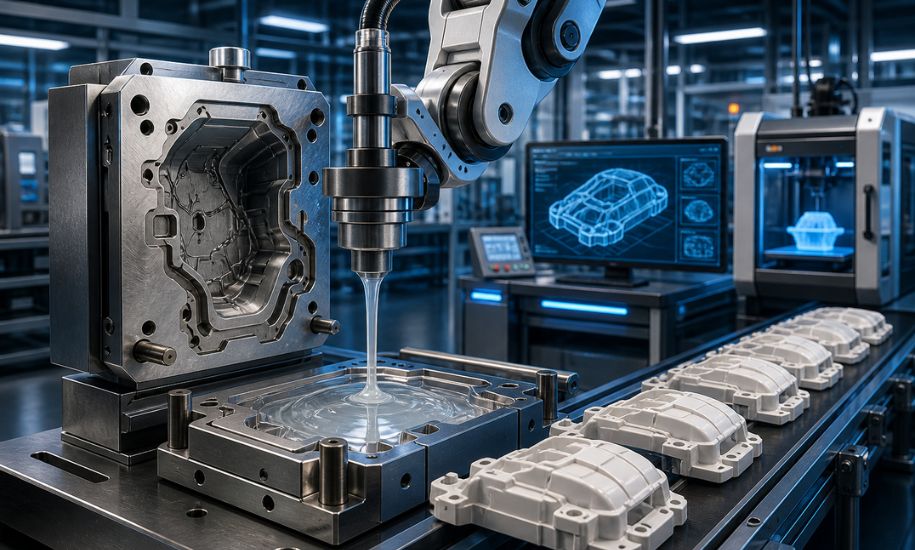
Modern manufacturing is changing quickly. Companies want to move from digital designs to physical products with less wasted time, lower development costs, and greater consistency. Advances in computer-aided design, rapid prototyping, 3D printing, silicone molding, resin casting, automation, and digital quality control have made this possible across many industries.
The term Repmold is often associated with this broader idea of replication molding and streamlined product reproduction. Rather than treating molding as an isolated manufacturing step, the concept can be understood as part of a workflow that connects digital design, prototype development, mold making, material selection, replication, and quality inspection.
That distinction matters because there is no single universal manufacturing process that fits every product. The appropriate method depends on factors such as the part’s geometry, material, production volume, required tolerances, tooling costs, and intended application.
In this guide, we’ll explain what Repmold can mean in a modern manufacturing context, how replication molding works, which technologies support it, where it can be useful, and what limitations manufacturers should consider before adopting a particular workflow.
What Is Repmold?
Repmold can be used to describe a streamlined approach to reproducing physical components from an existing model, prototype, pattern, or digital design.
The basic principle is straightforward:
Create or prepare a master model → create a mold → reproduce the desired component → inspect the result.
Depending on the application, the master model may be produced through traditional machining, sculpting, CAD-based manufacturing, or 3D printing. The mold itself may be made from silicone, metal, polymer, or another suitable material.
The resulting parts can then be produced from materials such as resin, plastic, rubber, composite materials, or other compatible compounds.
Rather than being a replacement for every conventional manufacturing process, Repmold is better understood as a replication-oriented workflow that can be adapted to different production requirements.
How Replication Molding Has Evolved
Molding and casting are not new ideas. Manufacturers have reproduced objects using molds for centuries. What has changed is the technology surrounding the process.
Traditional Mold Making
Earlier workflows often depended heavily on manually produced patterns and molds. Skilled workers were responsible for measurements, finishing, mold preparation, and inspection.
This could work extremely well, but making design changes was often expensive and time-consuming.
Digital Manufacturing
CAD software introduced a more precise way to design and modify components. Engineers could create detailed digital models before manufacturing a physical part.
Digital measurement and computer-controlled equipment also improved repeatability.
Rapid Prototyping
3D printing added another important step. A digital model can be transformed into a physical prototype relatively quickly, allowing designers to check dimensions, appearance, fit, and function before committing to more expensive tooling.
Connected Manufacturing
Modern workflows increasingly combine CAD, additive manufacturing, molding, automation, scanning, and quality-control technologies.
This interconnected approach is where concepts such as Repmold become particularly relevant.
How a Repmold-Style Workflow Works
The exact workflow varies according to the product and material, but a typical replication process can involve several stages.
1. Create the Master Design
The process begins with a physical master or a digital model.
A CAD file can define dimensions, curves, holes, surface details, and other characteristics. If an existing object needs to be reproduced, 3D scanning can sometimes be used to capture its geometry.
2. Produce a Prototype
A prototype allows designers to identify problems before creating production tooling.
3D printing is particularly useful for this stage because it can produce complex shapes without requiring conventional tooling first.
3. Prepare the Mold
The mold must accurately capture the geometry of the master.
Silicone molds are often useful for smaller batches and detailed shapes, while more durable tooling materials can be appropriate for larger production runs.
The mold design also needs to account for issues such as:
- Parting lines
- Draft angles
- Undercuts
- Air evacuation
- Material shrinkage
- Demolding requirements
4. Select the Replication Material
The material depends on the required characteristics of the finished component.
Possible options include:
- Resins
- Thermoplastics
- Silicone or elastomers
- Polyurethane materials
- Composite materials
- Specialized casting compounds
Material selection affects strength, flexibility, durability, appearance, heat resistance, and cost.
5. Produce the Parts
Once the mold is ready, the selected material is introduced using the appropriate process.
Depending on the technology, this might involve casting, injection molding, compression molding, or another manufacturing technique.
6. Inspect and Refine
Finished components should be inspected for dimensional accuracy, surface defects, incomplete filling, deformation, and other problems.
If issues appear consistently, the mold, material, process parameters, or original design may need adjustment.
Why Digital Design Is Important
One of the biggest advantages of modern replication workflows is the connection between digital information and physical production.
A CAD model provides a reference that can be modified before manufacturing begins. This makes experimentation easier than repeatedly modifying physical tooling.
For example, a designer may change:
- Wall thickness
- Mounting points
- Surface geometry
- Dimensions
- Internal structures
- Assembly features
The revised design can then be prototyped and evaluated before a larger production run.
This digital-to-physical workflow can reduce unnecessary iterations and help teams identify design problems earlier.
The Role of 3D Printing
3D printing and molding are often complementary rather than competing technologies.
A manufacturer might use additive manufacturing to create a master pattern and then use that pattern to produce multiple molded parts.
This approach can be useful when:
- The design is still evolving
- Initial quantities are relatively small
- Complex geometry is required
- Conventional tooling would be expensive
- A physical prototype is needed quickly
However, 3D printing is not automatically the best option for every production requirement. For very high volumes, conventional molding processes can offer advantages in cycle time and per-unit cost.
Materials Used in Replication Workflows
Material selection is one of the most important decisions in any molding process.
Silicone
Silicone is widely used for flexible molds because it can capture detailed shapes and allow relatively easy demolding.
Resin
Resins can produce detailed components and are commonly used for prototypes, models, decorative products, and small-batch applications.
Thermoplastics
Thermoplastics are important in large-scale manufacturing because many can be repeatedly softened and processed through appropriate molding methods.
Polyurethane
Polyurethane materials are available in formulations offering different combinations of hardness, flexibility, and durability.
Composites
Composite materials can provide specialized mechanical properties and are used where strength-to-weight performance or other characteristics are important.
The correct material should always be selected according to the actual engineering requirements rather than simply choosing the cheapest option.
Key Benefits of a Replication-Based Manufacturing Approach
A well-designed replication workflow can provide several advantages.
Faster Prototyping
Digital design and rapid prototyping can shorten the time needed to evaluate a new concept.
Repeatability
A properly designed mold can produce multiple parts with consistent geometry, provided that the process is controlled correctly.
Lower Costs for Suitable Volumes
For small or medium production runs, certain molding methods can be more economical than creating highly specialized industrial tooling.
Design Flexibility
Digital models can be modified before committing to production tooling.
Detailed Surface Reproduction
Molding can reproduce fine surface features from a suitable master model.
Scalable Production
The appropriate molding technology can support everything from prototypes to larger production quantities, although the economics change significantly with volume.
Repmold vs. Traditional Manufacturing
It is more useful to compare specific processes than to assume that one method is universally better.
| Factor | Conventional Manufacturing | Replication-Oriented Workflow |
|---|---|---|
| Prototyping | Can require more preparation | Often well suited to rapid prototypes |
| Design changes | May require tooling changes | Digital changes can simplify iteration |
| Small batches | Can be expensive depending on process | Often attractive for suitable quantities |
| Large-scale production | Highly capable | Depends on the molding technology used |
| Surface reproduction | Process-dependent | Can be highly detailed |
| Automation | Widely available | Can integrate with digital automation |
| Material choice | Very broad | Depends on mold and replication process |
The best solution depends on geometry, volume, tolerances, materials, and budget.
Quality Control in Modern Molding
Replication does not automatically guarantee identical parts. Quality depends on the entire production process.
Important quality-control considerations include:
Dimensional Inspection
Measurements can be compared with the original CAD model or engineering specifications.
Surface Inspection
Manufacturers check for scratches, bubbles, incomplete filling, warping, and other visible defects.
Material Consistency
Incorrect mixing ratios, contamination, moisture, or unsuitable curing conditions can affect finished parts.
Mold Condition
Molds can gradually deteriorate through repeated use. Regular inspection helps maintain consistency.
Process Documentation
Recording production parameters makes it easier to identify the cause of recurring defects.
Can AI Improve Replication Manufacturing?
Artificial intelligence can support manufacturing, but it should not be presented as an automatic requirement of Repmold.
AI and machine-learning systems can potentially assist with:
- Detecting visual defects
- Analyzing production data
- Predicting equipment maintenance needs
- Optimizing certain process parameters
- Identifying patterns in quality-control measurements
Computer vision, for example, can inspect components for surface abnormalities more consistently than manual inspection in some production environments.
However, AI is an optional supporting technology, not what defines molding itself.
Applications of Replication Molding
Replication-based manufacturing can be useful across many fields.
Product Prototyping
Design teams can create several physical versions of a product before finalizing its design.
Automotive Development
Manufacturers and suppliers can use molding and rapid prototyping for selected interior components, design models, fixtures, and development parts.
Consumer Products
Small-batch products, housings, decorative components, and product prototypes can benefit from replication techniques.
Industrial Components
Certain low-volume or specialized components may be produced using suitable molding processes.
Medical and Research Applications
Some development projects use molding and casting to create prototypes, models, training components, or specialized parts. Medical applications require particularly careful material selection, validation, and regulatory compliance.
Art and Model Making
Replication molding is also valuable for sculptures, collectibles, props, miniatures, and detailed models.
Sustainability Considerations
Manufacturing sustainability is more complicated than simply describing a process as “eco-friendly.”
A replication workflow can potentially reduce waste when prototypes and tooling are optimized before production. Digital design can also reduce unnecessary physical iterations.
However, environmental impact depends on:
- Material choice
- Mold lifespan
- Energy consumption
- Production volume
- Scrap rates
- Recycling options
- Transportation
- End-of-life disposal
For that reason, manufacturers should evaluate the complete production lifecycle rather than assuming that one technology is automatically sustainable.
Challenges and Limitations
Despite its advantages, replication molding has limitations.
Tooling Costs
Some molding processes require significant investment in molds or specialized equipment.
Mold Wear
Repeated production can eventually damage or degrade a mold.
Design Restrictions
Complex undercuts, enclosed cavities, and difficult geometries can complicate mold design.
Material Compatibility
A mold material must be compatible with the substance being cast or injected.
Shrinkage and Distortion
Some materials change dimensions during curing or cooling. These changes need to be considered during design.
Production Volume
A process that makes sense for 20 parts may not be economical for 20,000 parts.
Understanding these limitations is essential when choosing a manufacturing method.
How to Choose the Right Replication Process
There is no universal “best” molding method. Start with the product requirements.
Ask:
- How many parts are required?
- What material should the final component use?
- What dimensional tolerances are necessary?
- How complex is the geometry?
- How detailed is the surface?
- How frequently will the design change?
- How long should the mold last?
- What is the acceptable tooling budget?
- Does the finished part need specific mechanical or thermal properties?
- What inspection standards must be met?
Answering these questions makes it easier to determine whether silicone molding, resin casting, injection molding, 3D printing, machining, or another process is appropriate.
The Future of Digital Replication
The future of manufacturing is increasingly connected.
CAD platforms, 3D scanners, additive manufacturing systems, automated machinery, digital inspection tools, and data analytics can work together to shorten development cycles and improve production visibility.
This does not mean traditional manufacturing will disappear. Instead, manufacturers are likely to combine technologies according to the requirements of each product.
A future replication workflow could involve:
- Automated design verification
- AI-assisted inspection
- Faster 3D scanning
- More capable additive manufacturing
- Digital twins
- Automated mold monitoring
- Connected production systems
These technologies can make manufacturing more responsive without eliminating the need for experienced engineers and technicians.
Repmold and Industry 4.0
Industry 4.0 focuses on connected, data-driven manufacturing.
A replication-oriented workflow can fit into this environment when digital design, production equipment, sensors, inspection systems, and manufacturing data are connected.
For example, a production line could record process information for every batch while automated inspection identifies deviations from expected dimensions.
The important point is that Repmold itself should not be treated as synonymous with Industry 4.0. Rather, replication molding can become one component within a broader smart-manufacturing ecosystem.
FAQ
What does Repmold mean?
Repmold can refer to a replication-focused molding approach in which a master model or digital design is used to create multiple physical components. The exact meaning can vary depending on the context in which the term is used.
Is Repmold the same as 3D printing?
No. 3D printing creates objects layer by layer, while molding uses a mold to reproduce a shape. The two technologies can be used together—for example, a 3D-printed master can be used to create a mold.
What materials can be used for replication molding?
Depending on the process, materials can include silicone, resins, thermoplastics, polyurethane, rubber-like materials, and composites.
Is replication molding suitable for mass production?
It can be, but suitability depends on the specific molding technology, tooling, material, production volume, and required cycle time. High-volume manufacturing often uses specialized tooling designed for repeated production.
Does AI have to be used?
No. AI can support design optimization, inspection, analytics, and predictive maintenance, but conventional molding can operate without artificial intelligence.
Is replication molding cheaper than traditional manufacturing?
Not always. It can be cost-effective for prototypes and certain small- or medium-volume applications, but the most economical method depends on tooling, material, labor, machine time, and production volume.
Final Thoughts
Repmold is best understood in the context of modern replication and molding rather than as a universal replacement for conventional manufacturing. Its value comes from combining established molding principles with digital design, rapid prototyping, scanning, automation, and modern quality-control techniques where those technologies make sense.
The most important advantage is flexibility. A manufacturer can create a digital model, test a physical prototype, refine the design, produce a suitable mold, and then replicate the component according to the required production volume.
At the same time, successful manufacturing still depends on fundamentals: accurate design, appropriate materials, reliable tooling, controlled processes, and thorough quality inspection.
As digital manufacturing continues to develop, replication workflows are likely to become increasingly connected and automated. The companies that benefit most will not necessarily be those using the newest technology, but those that understand which technology is appropriate for the product, volume, budget, and quality requirements.
That practical balance between innovation and manufacturing fundamentals is what makes modern replication technology an important part of the evolving industrial landscape.
