


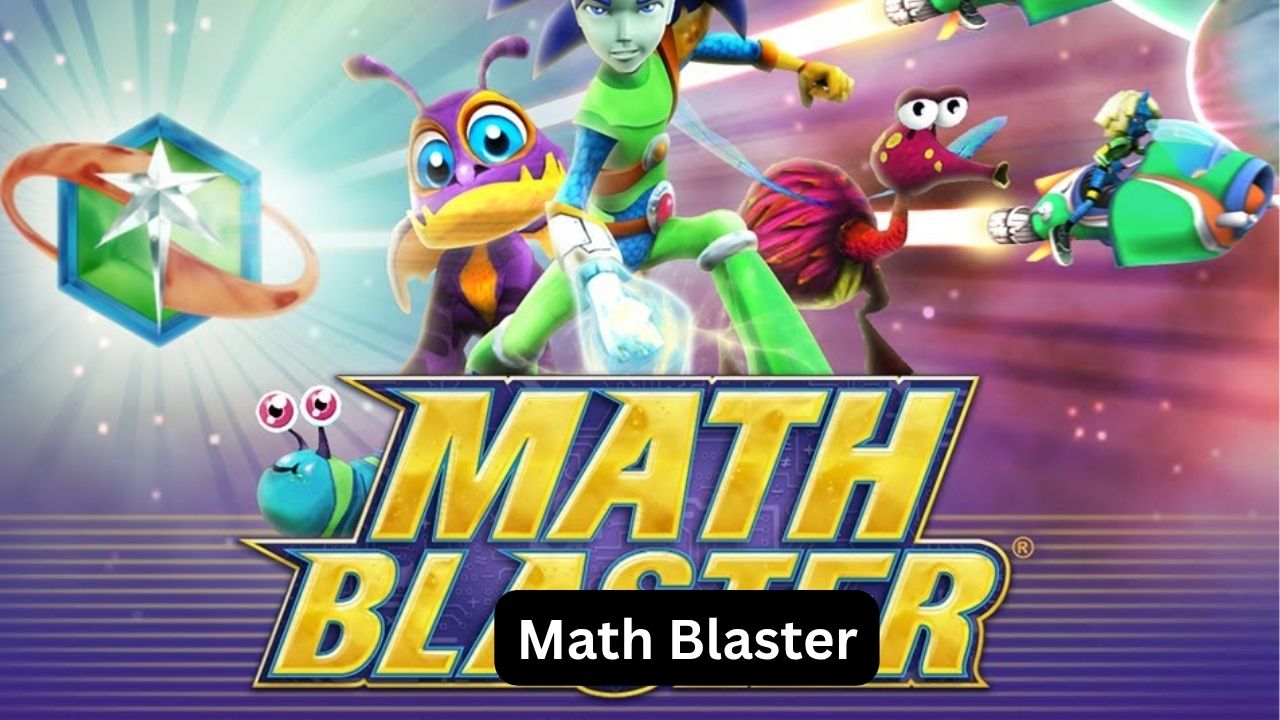
If you remember solving math problems by blasting the right answer instead of filling out a worksheet, you probably remember Math Blaster. What began in 1983 as an educational computer game became one of the best-known math-focused game series of the 1980s and 1990s. The original was created by Davidson & Associates and combined arithmetic practice with arcade-style gameplay.
Today, people search for Math Blaster for very different reasons. Some want to revisit a childhood 90s computer game, others are looking for Math Blaster online, a free version, the Mystery games, Geometry Blaster, or the Math Blaster Ages 9–12 edition. The tricky part is that “Math Blaster” refers to an entire family of releases rather than one single game.
This guide explains what Math Blaster actually was, how the series evolved, which versions are worth knowing, what students learned from them, and what to consider if you want to play an older version today.
What Is Math Blaster?
Math Blaster is an educational video game series designed to make mathematics practice feel more like an arcade game than traditional schoolwork.
The original Math Blaster! launched in 1983 for computers including the Apple II, Atari 8-bit systems, Commodore 64, and IBM PC. It focused on elementary mathematics, particularly addition, subtraction, multiplication, division, fractions, percentages, and decimals.
Its basic idea was surprisingly effective:
- A mathematical problem appeared.
- Several possible answers were presented.
- The player had to identify the correct answer.
- The game rewarded accurate and fast responses.
Instead of treating calculation as a worksheet exercise, Math Blaster turned it into a challenge involving timing, movement, and arcade-style action.
That design helps explain why the game remained memorable long after newer educational software appeared.
Why Was Math Blaster So Popular?
The strongest feature of Math Blaster was not its mathematics curriculum alone. It was the way the game changed the feeling of practice.
A child who might resist doing 20 multiplication questions on paper could become much more interested when the same skill was connected to a game objective.
The original game used cannons and targets as part of its gameplay. Players moved toward the cannon corresponding to the correct answer, while timers created pressure to respond quickly. The difficulty and speed could be adjusted for different skill levels.
This produced an important learning loop:
Question → decision → action → immediate feedback → next question
That loop is one reason Math Blaster feels more like a game than digital homework.
Another unusual feature was an editor that allowed parents and teachers to create their own problems. That made the software more flexible than a fixed collection of exercises.
Math Blaster Through the 1980s and 1990s
One common mistake is to think of Math Blaster as a single 90s game. Its history is much longer.
1983: The Original Math Blaster
The first Math Blaster appeared in 1983 and concentrated heavily on arithmetic drill and practice.
It covered skills such as:
- Addition
- Subtraction
- Multiplication
- Division
- Fractions
- Decimals
- Percentages
It was also tested in educational settings and became a significant success in educational computing.
1987: Math Blaster Plus!
Math Blaster Plus! revised the original concept and expanded the presentation.
The series continued developing as computer hardware became more capable, eventually leading to New Math Blaster Plus! in 1990.
1993: Math Blaster Episode I
A major change came with Math Blaster Episode I: In Search of Spot.
Instead of simply presenting disconnected exercises, the game introduced a stronger adventure structure involving Blasternaut, Spot, and Galactic Commander. The 1993 version was released for DOS, with later versions appearing on other platforms.
This was an important evolution: mathematics was no longer just the activity. It became part of the reason for progressing through an adventure.
1994: Episode II and Mystery
The following year brought Math Blaster Episode II: Secret of the Lost City and Math Blaster Mystery: The Great Brain Robbery.
This is where searches for “Math Blaster Mystery” often become confusing. Mystery was a related title within the broader Blaster Learning System, rather than simply another name for the original game.
1996–1999: The Ages Series
The franchise was redesigned again during the late 1990s.
Mega Math Blaster appeared in 1996 and was later associated with the Ages 6–9 branding. Subsequent releases included versions aimed at older children, including Math Blaster: Ages 9–12.
That age-based approach made sense because a seven-year-old and an eleven-year-old obviously needed very different mathematical challenges.
What Is Math Blaster Ages 9–12?
For people specifically searching for Math Blaster 9-12 download, the title they usually mean is the late-1990s Math Blaster: Ages 9–12.
This edition moved beyond simple arithmetic and introduced more advanced skills intended to prepare students for pre-algebra.
Its activities included:
- Equations with multiple operands
- Estimation
- Fractions with common denominators
- Fractions with uncommon denominators
- Decimals
- Percentages
- Patterns
- Problem solving
One current product listing describes the game as containing more than 50,000 problems across 10 skill areas and multiple difficulty levels.
The important point is that Ages 9–12 isn’t simply the original Math Blaster with harder numbers. It represents the franchise’s shift toward broader mathematical reasoning and preparation for pre-algebra.
Is Math Blaster a Geometry Game?
Yes, but with an important distinction.
People sometimes search for Math Blaster geometry because the broader Blaster Learning System included math-related spin-offs such as Geometry Blaster and Alge-Blaster.
Geometry Blaster therefore shouldn’t be confused with every version of the main Math Blaster series.
The distinction is useful:
| Game type | Main emphasis |
|---|---|
| Math Blaster | General mathematics |
| Alge-Blaster | Algebra |
| Geometry Blaster | Geometry |
| Math Blaster Mystery | Math combined with mystery/adventure |
| Ages 9–12 | Intermediate mathematics and pre-algebra preparation |
This specialization was actually one of the strengths of the larger educational software ecosystem. Instead of forcing every learner into exactly the same material, different titles targeted different mathematical skills.
What Made the Gameplay Different From a Worksheet?
A worksheet generally asks a student to produce an answer and move to the next problem.
Math Blaster added consequences for speed and accuracy.
In the original game, for example, a player had limited time to respond. The game used visual timers to create urgency.
That creates two separate skills:
Mathematical accuracy:
Can I calculate the answer correctly?
Retrieval speed:
Can I recognize or calculate the answer quickly enough?
That distinction matters in real learning. A student may understand multiplication but still need practice retrieving facts quickly.
A practical example
Imagine a student knows that:
7 × 8 = 56
but takes 15 seconds to arrive at the answer.
A traditional worksheet might show that the answer is correct.
A timed game exposes another issue: fluency.
That doesn’t mean speed should replace understanding. Rather, Math Blaster works best when it is used for fluency practice after the underlying concept has already been taught.
Three Less-Obvious Things About Math Blaster
1. The original game was partly a teacher tool
The original Math Blaster included an editor for creating customized problems. That means it wasn’t designed exclusively as a child’s entertainment product. Teachers and parents could adapt activities to particular needs.
That is easy to overlook when remembering it purely as a nostalgic computer game.
2. The limitations of old computers shaped the learning experience
The earliest software was built around extremely limited hardware and input systems. Research into the original editor shows that teachers faced strict limits on problem length, answer length, symbols, and formatting.
In other words, some of Math Blaster’s simplicity wasn’t necessarily a deliberate minimalist design choice. It was also a consequence of 1980s computing.
3. The franchise changed its identity repeatedly
The characters, stories, graphics, platforms, and educational focus evolved considerably over time.
The 1983 game was primarily arcade-style math practice. The 1993 Episode I introduced a more developed adventure and animated storytelling, while later releases were redesigned around specific age groups.
So two people can both remember “Math Blaster” and actually remember substantially different games.
Can You Play Math Blaster Online for Free?
This is where caution is useful.
There isn’t one universal, official “Math Blaster online free” version that represents the entire historical series. Different editions were released for different operating systems, and many were originally distributed commercially.
Some modern listings sell downloadable editions, including Math Blaster Ages 9–12.
Older versions may also be preserved through retro-gaming and software-archiving communities, but availability, legality, compatibility, and licensing can vary.
If you are looking for an old copy, avoid assuming that a random “free download” is legitimate simply because the game is decades old.
A safer approach is to check:
- Who is distributing the copy?
- Is the download authorized?
- Does it specify the original platform?
- Does it work with modern Windows?
- Is an emulator or compatibility layer required?
- Does the download contain unnecessary installers or suspicious executables?
The age of a game does not automatically mean that every downloadable copy is free to redistribute.
What About Math Blaster Unblocked?
“Math Blaster unblocked” usually appears in searches from students trying to access educational games on school computers.
The problem is that “unblocked” does not necessarily mean “official.”
School networks may restrict games because of bandwidth, security policies, classroom-management software, or website filtering. Trying to bypass those controls can violate school or workplace rules.
If the goal is simply to practice mathematics, the better solution is to use an approved educational resource or ask the administrator or teacher to provide access.
For someone trying to recreate the 90s computer game experience, a legitimate retro-compatible copy is a much better route than an unknown “unblocked” website.
Is Math Blaster Still Useful for Learning?
Yes—but it works best for the right purpose.
Math Blaster is particularly suitable for practice and fluency, rather than replacing mathematical instruction.
It can be useful for:
- Arithmetic fact practice
- Reinforcing fractions
- Practicing decimals and percentages
- Building calculation speed
- Motivating reluctant learners
- Reviewing previously taught concepts
However, games should not be expected to teach every mathematical idea from scratch.
For example, a child struggling to understand why fractions have common denominators needs an explanation, visual reasoning, and guided practice. A game can then provide repeated opportunities to apply that knowledge.
A useful learning routine
A simple 20-minute session could look like this:
- 5 minutes: Review the mathematical concept.
- 10 minutes: Play a focused Math Blaster activity.
- 5 minutes: Discuss mistakes and explain why the correct answers work.
This is generally more useful than letting the game run indefinitely.
Common Mistakes When Using Educational Math Games
Mistake 1: Chasing speed before understanding
A student may memorize patterns without understanding the mathematics.
Better approach: Teach the concept first, then use the game for reinforcement.
Mistake 2: Choosing the wrong age level
A game that is too easy quickly becomes boring. One that is too difficult can make the learner feel unsuccessful.
Better approach: Match the version to the student’s actual skill level, not simply their age.
Mistake 3: Treating every Math Blaster title as identical
The original 1983 game, Episode I, Mystery titles, and Ages editions have different designs and educational focuses.
Better approach: Identify the specific title before searching for downloads or compatibility information.
Mistake 4: Assuming nostalgia equals modern compatibility
A game that worked perfectly on a 1990s Windows computer may not run directly on a modern system.
Better approach: Check the original operating-system requirements and compatibility before purchasing or installing an old release.
Why Math Blaster Still Matters
Math Blaster is interesting because it represents an early attempt to solve a problem educators still face today:
How do you make repetitive practice feel rewarding?
The technology has changed dramatically since 1983, but the underlying design principle remains relevant. Immediate feedback, achievable challenges, progression, and a sense of play can make repeated practice more engaging.
The historical importance of Math Blaster isn’t simply that it was an old educational game. It demonstrated that learning software could borrow ideas from entertainment games without abandoning educational objectives.
That approach eventually became commonplace across educational technology.
FAQ
What year did the original Math Blaster game come out?
The original Math Blaster! was released in 1983 by Davidson & Associates. It initially appeared on systems such as the Apple II, Atari 8-bit computers, Commodore 64, and IBM PC. Later versions expanded to additional platforms and operating systems.
Is Math Blaster a 90s computer game?
Math Blaster is often remembered as a 90s computer game, but the franchise actually began in 1983. Major releases during the 1990s—including Episode I, Episode II, Mystery, Mega Math Blaster, and the Ages series—helped establish its strong association with that era.
What is Math Blaster Mystery?
Math Blaster Mystery was a spin-off within the larger Blaster Learning System. Titles included Math Blaster Mystery: The Great Brain Robbery, released in the 1990s, which combined mathematical activities with a mystery/adventure structure.
What is Math Blaster Ages 9–12?
Math Blaster: Ages 9–12 is a late-1990s edition designed for older elementary learners. It covers topics such as fractions, decimals, percentages, equations, estimation, and patterns, with the stated goal of developing intermediate skills and preparing learners for pre-algebra.
Can I download Math Blaster for free?
That depends on the specific edition and the source offering it. Some versions are commercially available as downloads, while older releases may be preserved elsewhere under varying licensing conditions. It’s important to verify that a free download is legally distributed and safe before installing it.
Was there a Geometry Blaster game?
Yes. Geometry Blaster was one of the math-focused spin-offs associated with the broader Blaster Learning System, alongside titles such as Alge-Blaster. It is therefore better understood as a specialized geometry title rather than simply another name for the original Math Blaster.
Conclusion
Math Blaster was much more than a nostalgic 90s computer game. Starting in 1983, it helped establish a model in which arithmetic practice could be combined with arcade-style challenges, immediate feedback, and adventure. The series subsequently expanded into Mystery titles, geometry and algebra spin-offs, story-driven episodes, and age-specific editions such as Math Blaster: Ages 9–12.
For someone revisiting the game today, the most important thing is to identify which Math Blaster they remember. The original 1983 experience is very different from the later 1990s adventure games.
And for learning, the same lesson still holds: Math Blaster works best not as a replacement for teaching, but as a memorable way to turn deliberate mathematical practice into something that feels like play.
