


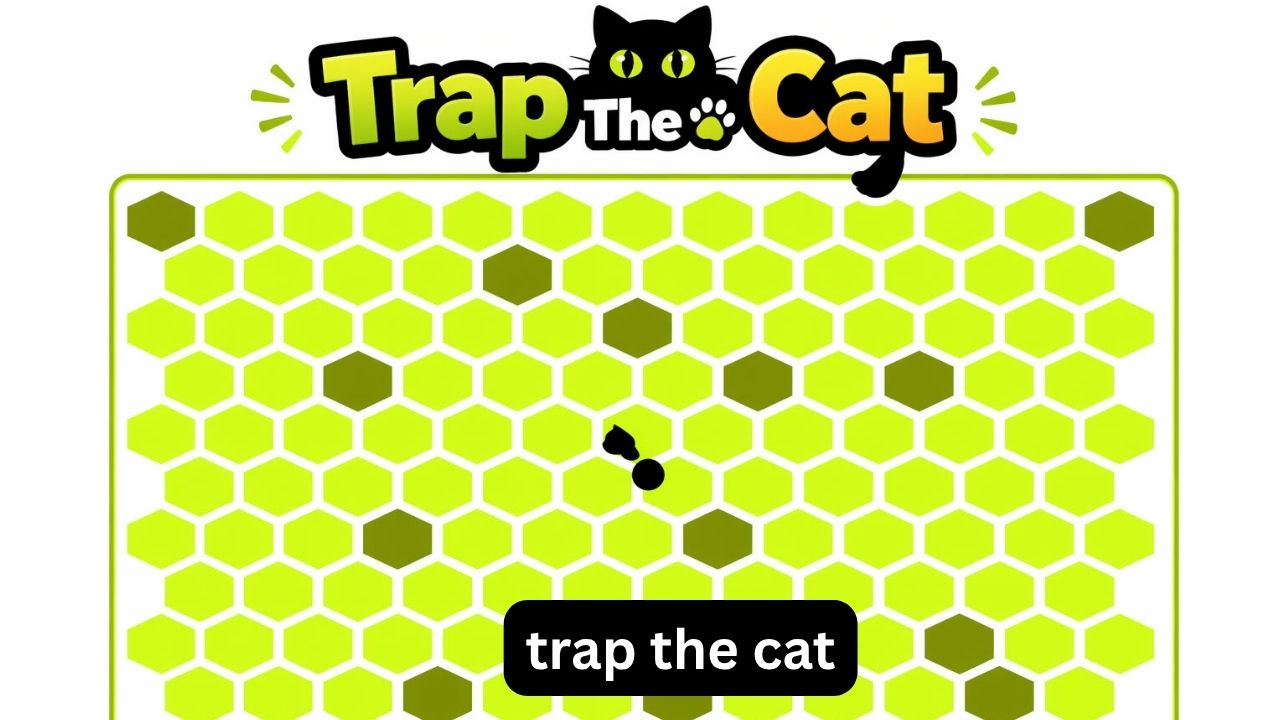
If you have searched for Trap the Cat, you may have expected a simple casual game involving a cat and a few clicks. The basic idea really is that simple: a cat sits inside a grid, and your job is to block its escape route. The difficult part is predicting where it will go after every move.
Trap the Cat is a deceptively clever logic puzzle. Browser versions generally use a hexagonal or circular-style grid, while the cat attempts to reach the outside edge. You place blocks one at a time, and the cat responds to your move. One careless block can create an escape route that was not obvious a moment earlier.
This guide explains how the game works, why it can feel unpredictable, how to improve your strategy, what people mean when they search for Trap the Cat unblocked or Trap the Cat SUS, and why searches for characters can sometimes lead to completely different versions of the game.
What Is Trap the Cat?
Trap the Cat is a small logic game based on surrounding a moving cat with blocked spaces before it reaches the edge of the board.
The classic concept is closely related to the older Circle the Cat puzzle. Modern browser versions have recreated the idea using HTML5, allowing the game to run on desktop and mobile browsers. One current version identifies itself as an HTML5 remake and allows players to either attempt to catch the cat or watch the game play automatically.
The rules are straightforward:
- The cat begins somewhere near the center of the board.
- You select an available tile.
- That tile becomes blocked.
- The cat moves toward an available escape route.
- You continue building a barrier.
- You win when the cat has nowhere to escape.
- You lose if the cat reaches the edge.
That simplicity is exactly what makes the puzzle interesting. There are no complicated controls to learn. Your main advantage comes from understanding space and anticipating the cat’s next several moves.
How Trap the Cat Gameplay Works
At first, many players make the same mistake: they concentrate almost entirely on the cat’s current position.
That is usually too late.
Instead, think about where the cat will be two or three moves from now.
A blocked tile does more than occupy one square. It changes the shape of the entire remaining play area. A single well-placed block can eliminate several potential routes at once, while a badly placed block may leave the cat with a wide-open path.
Most versions use a grid where the cat can move between neighboring cells. Because the board is not a conventional square maze, players need to think in terms of connected paths rather than simply looking horizontally and vertically.
The One-Move Rule
A useful way to understand the game is:
Your move gives the cat an opportunity to respond.
That means every block has a cost. You cannot simply fill the board while the cat waits.
This creates the central strategic question:
Which tile removes the greatest number of useful escape routes?
That is a much better question than:
Which tile is closest to the cat?
Why Trap the Cat Is Harder Than It Looks
The board looks small, but the number of possible routes can become surprisingly large.
Imagine that the cat appears to have only one open direction. You might assume it is trapped soon. However, that open route may connect to several other spaces. Once the cat moves into that area, it can suddenly have another route toward the edge.
This is why experienced players often build a perimeter instead of trying to create a tiny cage immediately around the cat.
The goal is not necessarily to surround the cat as quickly as possible.
The goal is to control where the cat can go.
That distinction is one of the most useful insights for beginners.
The Best Strategy for Trap the Cat
There is no single opening move that guarantees victory on every board because the starting arrangement and available paths can differ. However, several principles consistently make the puzzle easier.
1. Don’t Chase the Cat
One of the most common beginner mistakes is clicking directly beside the cat again and again.
It feels logical, but it can waste valuable moves.
Instead, look farther ahead and identify the direction that gives the cat the most freedom.
If the cat can escape toward three sides, a block that removes one of those routes may be more valuable than a block directly beside it.
2. Build Connected Walls
Individual blocked tiles are not nearly as powerful as connected barriers.
Think of your blocks as pieces of a fence.
A connected wall can force the cat into a narrower section of the board. Once the movement area becomes smaller, the remaining escape routes become easier to control.
This is one of the most important practical differences between random play and deliberate play.
3. Control the Open Side
If the cat has several possible directions, look for the route that ultimately leads toward the nearest edge.
You do not always need to block the cat’s current direction. Sometimes blocking a later junction is more effective.
This creates a useful mental model:
Cat → route → junction → edge
Your job is to interrupt that chain before the cat reaches the edge.
4. Look for Junctions
A junction is a location from which the cat can potentially access several routes.
These spaces are extremely valuable.
If you block a junction, you may eliminate multiple escape possibilities with one move.
This is generally better than spending several moves blocking routes individually.
5. Leave Yourself Options
Another subtle mistake is building a barrier that looks strong but leaves you with no useful follow-up move.
Every turn should be considered in two directions:
- Where can the cat move next?
- Where can I place my next block?
A good move should ideally make both answers easier.
A Simple Example of Better Play
Suppose the cat is in the center and the right side of the board has a large open area.
A beginner may immediately block a tile next to the cat.
The cat then moves toward the right.
The beginner blocks another nearby tile.
The cat moves again.
After several turns, the player discovers that the cat has simply moved around the blocks and reached the outside.
A stronger approach would be to examine the right-side area first.
If several paths eventually merge into one narrow route, blocking that route can be much more efficient. The cat may then be forced back toward the center, where your existing blocks become more useful.
This is the difference between reactive play and route control.
Three Advanced Insights Most Players Miss
Think in Terms of Area, Not Tiles
A surprisingly effective way to improve is to stop counting individual blocks and start looking at the amount of open territory available to the cat.
A move that reduces a large open region can be more valuable than one that blocks a single obvious route.
This changes how you evaluate the board.
The Edge Is the Real Opponent
The cat itself is not necessarily the most important thing to watch.
The edge is.
If the cat has a short, unobstructed path to the border, you are under pressure even if the cat appears far away from your blocks.
Conversely, a cat that is relatively close to you may still be safe if its available routes are heavily restricted.
A “Nearly Trapped” Cat Can Be Dangerous
Players often become careless when the cat appears almost surrounded.
That is precisely when you should slow down.
A single remaining route may connect to a surprisingly large portion of the board. Before placing your next block, mentally trace that route all the way to the edge.
If it connects to open space, the cat is not truly trapped yet.
Trap the Cat Unblocked: What Does It Mean?
The phrase Trap the Cat unblocked usually refers to people looking for a browser version that they can access when games are restricted on a school, workplace, or managed network.
“Unblocked” does not normally describe a special game mode. It generally describes the availability of a particular website or game page on a network.
There are several reasons a browser game might not load:
- School or workplace filtering
- Network-level restrictions
- Browser policies
- Blocked gaming domains
- Local administrator settings
- Compatibility problems
The important distinction is that unblocked is about access, not gameplay.
If you are using a managed network, restrictions may be intentional. On a personal device, using a legitimate browser version that is compatible with your connection is the simplest approach.
Is Trap the Cat Available on Mobile?
Yes. Several versions are designed to work through mobile browsers, and dedicated mobile versions also exist.
For example, the Google Play version of Trap the Cat describes itself as a puzzle game in which players click bright green hexagons to block the cat’s route. It also states that the game can be played offline.
Browser versions generally replace mouse clicks with touchscreen taps.
The controls are simple, but a larger screen can make the board easier to analyze because the entire pattern is visible at once.
What Does “Trap the Cat SUS” Mean?
The Trap the Cat SUS search can be confusing because “sus” is internet slang for “suspicious.”
It does not represent a standard gameplay mechanic in the classic puzzle.
People may use the phrase as a meme, joke, nickname, or reference to a modified version of the game. If you encounter a page using unusual terminology around Trap the Cat, it is worth checking whether it is actually the traditional puzzle or a fan-made project.
For the standard game, the objective remains the same: restrict the cat’s available routes until it cannot escape.
What Are the Trap the Cat Characters?
The classic puzzle does not have a large cast of playable characters.
Its central elements are:
- The cat
- The game board
- The blocked tiles
- The player controlling the barriers
However, searches for Trap the Cat characters can lead to another project with the same name.
One notable example is a separate fan-made/adult-oriented Trap the Cat project associated with Project Physalis. Its official creator page lists characters including Ankha, Momo, Nicole Watterson, and Shima Luan.
This is important for searchers because the two experiences should not be confused.
The classic Trap the Cat is a logic puzzle.
The Project Physalis title is a separate fan-made project with adult themes and a different presentation. It is not simply another level or character mode of the traditional puzzle.
What Is the Project Physalis Version of Trap the Cat?
Project Physalis released a separate version of Trap the Cat, with a definitive version announced in January 2021. The creator’s post identifies downloadable PC, Android, and WebGL versions and lists several associated character names.
The project is also listed separately on Newgrounds under the Project Physalis name.
For someone searching specifically for Project Physalis Trap the Cat, this distinction is useful because ordinary browser searches can mix results for the harmless puzzle with results for the unrelated adult-oriented fan project.
If your interest is simply the strategy puzzle, you do not need the Project Physalis version to understand or play the classic game.
Common Trap the Cat Mistakes
Blocking Too Close to the Cat
This is probably the biggest beginner mistake.
A nearby block may look useful but provide very little control over the wider board.
Ignoring the Opposite Side
Players often stare at the cat and forget to examine the opposite side of the board.
Always check where the open paths eventually lead.
Filling Random Tiles
Random clicking can occasionally work, but it teaches you very little.
Instead, ask what each block accomplishes.
Assuming the Cat Moves Randomly
The cat can appear unpredictable because its available routes change after every block. However, successful play is less about guessing and more about understanding its available movement and controlling the surrounding space.
Giving Up After One Failed Attempt
Trap the Cat is particularly suitable for repeated attempts because each loss gives you information.
Ask:
- Which route did I fail to close?
- Which block was unnecessary?
- Where did the cat gain freedom?
- Could I have blocked a junction earlier?
That turns a failed round into useful practice.
A Practical Routine for New Players
If you are struggling to win consistently, try this routine:
- Pause before the first important block.
- Identify the cat’s most open escape direction.
- Look for a junction farther along that route.
- Place a block that reduces multiple possibilities.
- Watch the cat’s response.
- Recalculate instead of repeating the same pattern.
- Build connected barriers whenever possible.
- Before every move, trace at least one complete route to the edge.
After a few rounds, you will begin to recognize patterns instead of seeing a collection of random tiles.
Is Trap the Cat Worth Playing?
For a game with such simple mechanics, Trap the Cat has impressive replay value.
It does not require fast reflexes, complicated controls, or a large tutorial. Instead, it rewards spatial reasoning and planning.
That makes it particularly good for short sessions. Some browser versions describe rounds as quick, repeatable logic challenges, while mobile versions provide the same basic concept in a more convenient format.
The biggest appeal is the moment when you stop reacting to the cat and start predicting it.
Once you understand that, the board suddenly feels much less random.
FAQ
Is Trap the Cat free to play?
Many browser versions of Trap the Cat are available to play for free. There are also mobile versions with different monetization models, including ads or optional purchases. The Google Play version, for example, is listed as containing ads and in-app purchases.
How do you win Trap the Cat?
You win by blocking the cat’s available escape routes before it reaches the edge of the board. The most effective approach is usually to control routes and junctions rather than placing blocks randomly around the cat. Think several moves ahead and build connected barriers.
Is Trap the Cat unblocked a different game?
Usually, no. “Unblocked” generally refers to finding a version of the browser game that is accessible on a network where gaming sites may be restricted. It does not normally represent a separate official gameplay mode.
Can I play Trap the Cat on a phone?
Yes. Browser versions can support mobile touch controls, and dedicated mobile versions are also available. The exact experience depends on which version you use, but the core puzzle remains based on selecting tiles and restricting the cat’s movement.
What does Trap the Cat SUS mean?
“SUS” is generally internet slang for “suspicious” and is not a standard feature of the classic puzzle. The phrase can appear in memes, player discussions, or searches for modified versions, so the exact meaning depends on the page or community using it.
Are the Project Physalis characters part of the original game?
No. Project Physalis is associated with a separate fan-made version of Trap the Cat. Its creator’s published information identifies characters including Ankha, Momo, Nicole Watterson, and Shima Luan, making it distinct from the traditional cat-and-grid puzzle.
Final Thoughts
Trap the Cat succeeds because it turns a tiny rule set into a surprisingly deep strategy puzzle. You only need to place blocks, but every placement changes the cat’s future options.
The biggest improvement comes from changing your mindset. Don’t chase the cat. Control its routes. Don’t focus only on nearby tiles. Look for junctions, connected barriers, and the paths leading toward the edge.
And if your search brought you here through terms such as Trap the Cat unblocked, Trap the Cat SUS, or Project Physalis Trap the Cat, remember that those searches can refer to different versions or communities. The classic game remains a simple logic puzzle, while some similarly named fan projects are separate experiences.
Once you start thinking about territory instead of individual moves, trapping the cat becomes much more predictable—and much more satisfying.
