


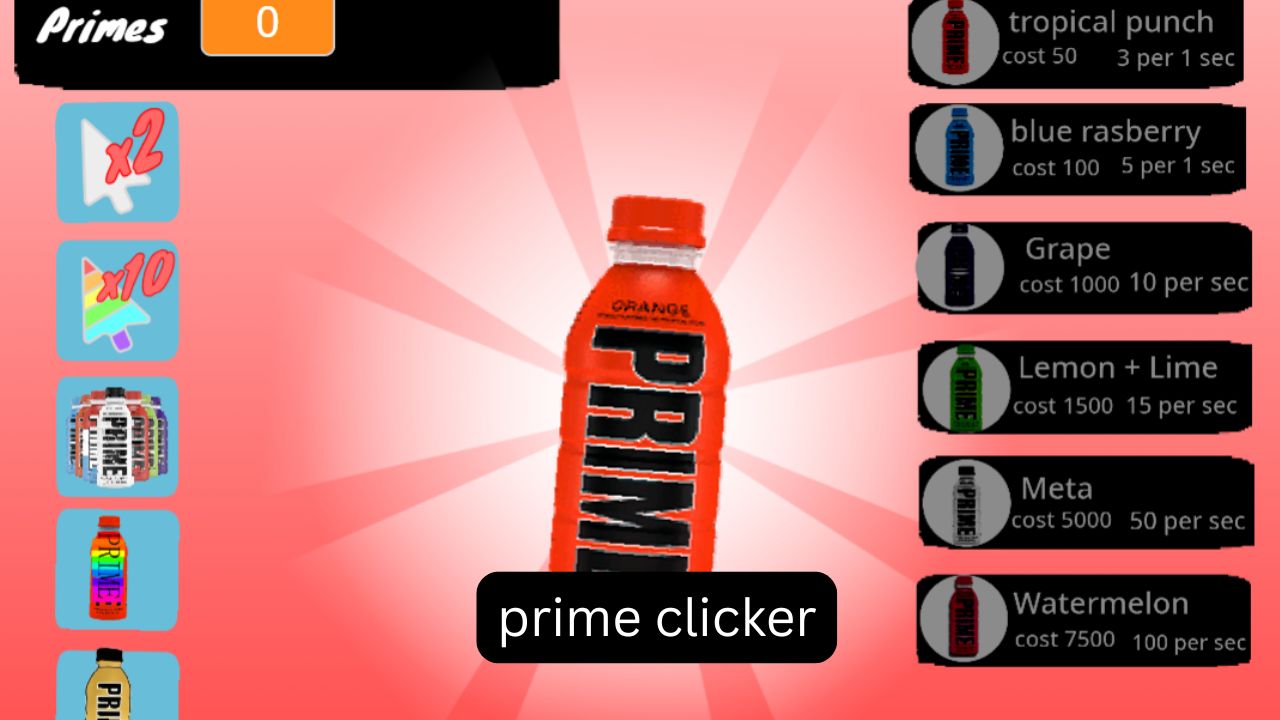
If you enjoy simple games where every click moves you closer to the next upgrade, Prime Clicker game is an easy one to get into. The basic idea is straightforward: click, earn more, buy upgrades, and repeat until your numbers start growing quickly. The name “Prime Clicker” is used by multiple Scratch projects and remixes, so the exact features can vary depending on which version you play.
That variety is actually part of what makes Prime Clicker interesting. Scratch has hosted several projects with the same or similar name, including versions with different updates, remixes, and community-made modifications. One Scratch project, for example, appears in a large remix chain containing versions labeled from early releases through version 10.0 and beyond.
This guide explains how Prime Clicker works, where to find a free version, what “Prime Clicker Scratch codes” usually means, how to approach upgrades, and what to watch for when a version claims to be hacked or modified.
What Is Prime Clicker Game?
Prime Clicker is a clicker-style game made in or around the Scratch community. The basic gameplay loop is familiar:
- Click the main object or button.
- Earn an in-game currency or score.
- Spend that currency on upgrades.
- Increase the amount earned per click or over time.
- Continue upgrading to reach larger numbers.
There is not necessarily one single official Prime Clicker with a fixed feature set. Scratch contains many projects called Prime Clicker, including original-looking projects, remixes, updated versions, and unofficial modifications.
For example, Scratch’s remix listings show numerous Prime Clicker variations, including projects described as version 7.0, 8.0, 9.0, 10.0, hacked versions, and other customized editions.
That means two players can search for “Prime Clicker” and end up playing noticeably different games.
How Prime Clicker Gameplay Usually Works
The best way to understand a clicker game is to think about progression rather than individual clicks.
At the beginning, clicking manually may be the main way to earn currency. After a few upgrades, each click becomes more valuable. Eventually, passive income or automated mechanics can become more important than repeatedly pressing the button yourself.
A simple progression might look like this:
Manual clicking → stronger clicks → upgrades → automation → faster progression
The exact names and prices depend on the version.
Why Upgrades Matter More Than Fast Clicking
A common beginner mistake is focusing entirely on click speed.
Suppose one click gives you 1 coin. You could click hundreds of times, but if an upgrade increases your income to 5 coins per click, the upgrade can save considerable effort over the next few minutes.
This is why a useful strategy is to ask:
“Which purchase increases my future earning rate the most?”
rather than:
“What can I afford right now?”
That small change in thinking makes clicker games much more interesting.
Is Prime Clicker Free to Play?
Many Prime Clicker projects available through Scratch are playable for free because Scratch itself is a platform where users can create and share interactive projects.
However, “Prime Clicker” does not identify one single official game, so the experience depends on the project you open.
There are multiple community-created projects with that title. A Scratch discussion post from 2023, for instance, points users toward a Prime Clicker project, while other creators have published their own versions and remixes.
When looking for a free version, check:
- The project creator
- The project’s description
- Whether the project is playable
- Whether it is an original project or remix
- Whether the version appears complete
- Whether the creator mentions known bugs
This is more useful than assuming that every project carrying the Prime Clicker name is the same game.
Prime Clicker on Scratch
Scratch is particularly relevant to Prime Clicker because the platform allows users to play, inspect, remix, and modify projects, depending on how the creator has shared them.
Several Prime Clicker projects have generated long remix chains. One example has a large collection of related projects with different versions and modifications.
Another Scratch creator, banana_vr_sunburst, lists PRIME CLICKER among their featured projects and describes their broader work as including clicker and RPG games.
This community-driven structure creates an unusual situation: there can be many “versions” of what users casually call the same game.
Original vs. Remix
When you find a Prime Clicker project, look at its project information before assuming it is the original.
A remix may:
- Change the prices
- Add new upgrades
- Change the interface
- Modify the earning system
- Add jokes or references
- Increase the speed of progression
- Introduce bugs
- Add or remove saving features
Some versions are clearly labeled as remixes, while others use their own version numbers.
What Are Prime Clicker Scratch Codes?
The phrase “Prime Clicker Scratch codes” can mean different things depending on what the searcher is actually looking for.
It may refer to:
- Redeemable codes inside a particular version
- Cheat codes
- Secret combinations
- Scratch programming code
- Project variables
- Instructions for modifying the game
These should not be treated as the same thing.
Redeem Codes vs. Scratch Programming Code
A redeem code is something a player enters into a game to receive a reward.
Scratch code is the programming logic behind the project.
For example, a Scratch creator might use variables and blocks to control:
- Click value
- Currency
- Upgrade prices
- Automatic income
- Level progression
- Saving
- Special rewards
So if you are searching for “Prime Clicker Scratch codes” because you want working redeem codes, you need the exact Prime Clicker version. A code designed for one project may have no effect in another.
This is one of the least obvious issues with searching for codes for Scratch games: the title alone usually isn’t enough to identify the game’s code system.
Are There Working Prime Clicker Codes?
There is no reliable universal code list that applies to every Prime Clicker project.
The Scratch ecosystem contains multiple projects using the name, and the available versions can have different mechanics. Scratch’s remix pages demonstrate just how many variations exist.
If a particular version includes a code or redemption system, the safest place to check is its own project description or in-game instructions.
Be cautious with websites claiming that a single code works across every Prime Clicker version. A code can only work if the specific project has programming that recognizes it.
Prime Clicker Strategy: How to Progress Faster
If your version does not provide special codes, you can still improve progression significantly by managing upgrades intelligently.
1. Improve Your Income Rate First
Look for upgrades that increase the value of every click.
If an upgrade costs 100 coins but doubles your click income, it may provide much more long-term value than an upgrade that gives a small one-time bonus.
2. Don’t Spend Everything Immediately
Keep enough currency available to reach your next meaningful upgrade.
For example, imagine you have 480 coins and the next major upgrade costs 500. Buying a tiny cosmetic or low-impact upgrade for 450 coins may leave you back at the beginning of the earning cycle.
Saving for the stronger upgrade can sometimes produce faster overall progress.
3. Compare Cost With Payback
A useful clicker-game calculation is:
Payback time = Upgrade cost ÷ Extra income per second
Suppose an upgrade costs 1,000 coins and adds 100 coins per second.
The approximate payback period is:
1,000 ÷ 100 = 10 seconds
After those 10 seconds, the additional income is effectively working in your favor.
Not every Prime Clicker version will display income per second, but the principle still works whenever you can estimate the increase.
4. Look for Automation
If your version has an automatic earning feature, don’t overlook it.
Automation is especially valuable when you stop actively clicking. It turns short sessions into longer-term progression, provided the particular project supports persistent or continuous progress.
5. Test Upgrades Before Committing
If an upgrade has an unclear description, buy it only when the cost is manageable.
Some Scratch projects are experimental, and their mechanics may not be perfectly balanced. Community-created versions can contain unusual values, bugs, or unfinished features.
A Practical Example of Efficient Progression
Imagine you start with one coin per click.
You have three possible purchases:
- Upgrade A: +1 coin per click for 25 coins
- Upgrade B: +5 coins per click for 200 coins
- Upgrade C: +1 passive coin per second for 100 coins
At the beginning, Upgrade A may be attractive because it is inexpensive.
But after several minutes, the better choice could change depending on how frequently you click.
If you click constantly, click-based upgrades may provide greater returns. If you frequently stop clicking, passive income can become more valuable.
The important lesson is that there is no universal best upgrade without considering how you actually play.
That’s a useful principle for almost every incremental game.
Prime Clicker Hacks and Modified Versions
Search results for Prime Clicker also include projects explicitly described as “hacked,” “modded,” or otherwise modified. Scratch’s remix listings contain examples of these labels.
A modified version may change the normal progression by giving the player:
- Extremely high starting currency
- Faster clicking
- Lower upgrade costs
- Unlocked features
- Altered multipliers
- Other experimental mechanics
These versions can be entertaining if your goal is simply to experiment.
However, they can also remove the progression that makes a clicker game satisfying. If every upgrade is immediately affordable, there is little reason to plan purchases.
For that reason, it is worth deciding what you want from the game before choosing a modified version.
Common Prime Clicker Mistakes
Spending Currency Without a Plan
Buying the first affordable upgrade is easy, but it isn’t always efficient.
Compare several available upgrades first.
Assuming Every Version Uses the Same Codes
This is probably the biggest mistake when searching for Prime Clicker codes.
Different creators can build completely different mechanics under the same title.
Trusting “Hacked” Labels
A project labeled “hacked” is not automatically better or more complete.
It may simply have modified values.
Ignoring the Project Creator
Creator information matters because Scratch projects are community-made. If a project has updates, bug fixes, or a newer edition, the creator’s project page can provide useful context.
For example, one Scratch account specifically features a Prime Clicker project described as having a fixed bug.
Expecting Every Game to Save Progress
Saving behavior can differ from one Scratch project to another.
Don’t assume that closing the browser will preserve your progress unless the project clearly supports saving.
Three Things Many Prime Clicker Guides Miss
The Name “Prime Clicker” Is Ambiguous
This is the most important point.
Search engines may show several games with nearly identical titles. Treating all of them as one official game can lead to incorrect instructions, especially for codes and upgrades.
Version Numbers Can Be More Important Than the Title
If you are troubleshooting a code or feature, identify the version first.
“Prime Clicker V10” and another project simply called “Prime Clicker” may not share the same programming.
Scratch Makes Experimentation Part of the Experience
Unlike many commercial games, Scratch projects are often designed around experimentation and remixing.
That means a strange mechanic, unusual upgrade price, or different interface may not indicate an error. It can simply reflect how a particular creator built their version.
This is one reason Prime Clicker can appeal to people who enjoy both playing and understanding how games are made.
Is Prime Clicker Worth Trying?
If you enjoy incremental games, Prime Clicker is worth exploring primarily because of its simple gameplay loop and the variety of community-made versions.
It works particularly well for short sessions:
- You can start playing quickly.
- The basic objective is easy to understand.
- Progress is visible almost immediately.
- Upgrades create a simple sense of momentum.
- Different Scratch versions can offer different experiences.
For players interested in Scratch development, the projects can also be useful examples of how variables, buttons, upgrades, and progression systems can be combined into a playable game.
FAQ
Is Prime Clicker free?
Many Prime Clicker projects available through Scratch can be played for free. However, there are multiple projects with the same or similar name, so the exact gameplay and features depend on the version you choose. Check the individual project’s information before assuming it has the same mechanics as another Prime Clicker.
Where can I play Prime Clicker on Scratch?
Prime Clicker projects can be found on Scratch, where different creators have published original projects and remixes. Scratch search and project pages are useful for identifying the creator and version. Because many variations exist, check the project title and description before looking for codes or gameplay instructions.
Are there Prime Clicker Scratch codes?
Some versions may contain codes or other secret mechanics, but there is no universal code that should be expected to work across every Prime Clicker project. The exact programming determines which codes are recognized. If you have a particular version in mind, its project description and in-game instructions are the most relevant places to check.
What is the fastest way to progress in Prime Clicker?
Focus on upgrades that improve your long-term earning rate rather than simply purchasing whatever is cheapest. Compare the upgrade cost with the additional income it produces, and consider whether you spend most of your time clicking manually or relying on automation. Your playing style can change which upgrade provides the best return.
What is the difference between Prime Clicker and a hacked version?
A hacked or modified Prime Clicker usually changes the game’s normal values or mechanics, such as currency, upgrade costs, or multipliers. It may make progression much faster, but the exact changes depend on the creator. Scratch’s Prime Clicker remix ecosystem contains several projects using modified or hacked labels.
Can I make my own Prime Clicker in Scratch?
Yes. A basic clicker game can be built around variables that track currency, scripts that increase the currency when the player clicks, and upgrade systems that change the earning rate. Once the basic system works, you can add automation, levels, saving mechanics, animations, sounds, and other features. This makes Prime Clicker-style games a practical project for learning Scratch game development.
Conclusion
Prime Clicker is less a single standardized game than a family of Scratch projects and remixes built around the familiar click-and-upgrade formula. That distinction matters when you’re searching for a free version, troubleshooting a feature, or looking for Prime Clicker Scratch codes.
For the best experience, identify the specific project and version first. Then focus on efficient upgrades, compare long-term earning potential, and don’t assume that a code or strategy from one version will work in another.
The most interesting part of Prime Clicker may actually be its community-driven nature: different creators can take the same basic idea and turn it into completely different games. If you enjoy incremental gameplay—or want to learn how simple Scratch mechanics become a playable game—it’s a fun format to explore.
