


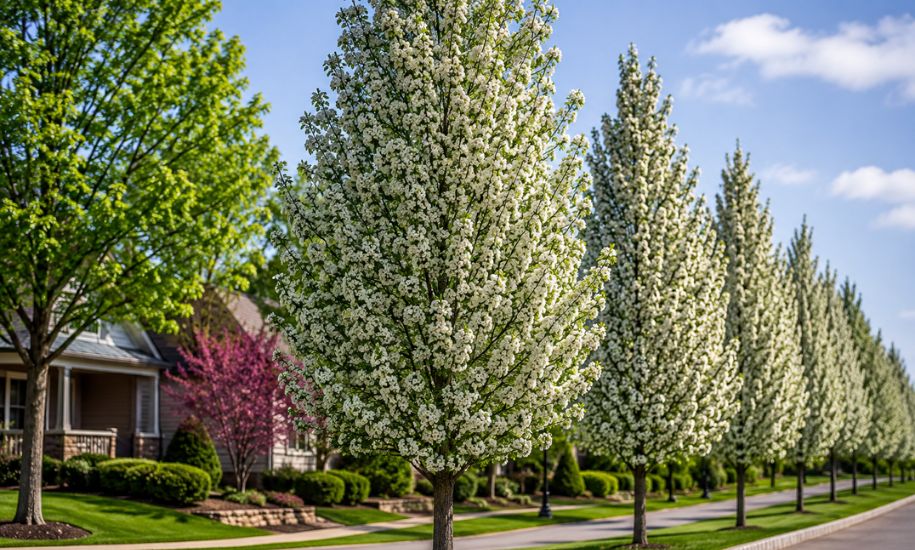
The Navigator pear is an ornamental pear valued for its tidy upright form, white spring flowers, glossy summer foliage, and attractive fall color. It is especially interesting to gardeners in colder regions because it was selected for hardy prairie-type conditions and is commonly listed as Pyrus × ‘DurPSN303’.
One important clarification is that Navigator pear is not primarily an orchard pear grown for large, edible fruit. It is a landscape tree chosen mainly for structure and seasonal appearance. Nursery descriptions also differ slightly on mature size, with common estimates ranging from roughly 23–26 feet tall to around 33–35 feet under favorable conditions.
That makes site selection particularly important. A tree that looks narrow when young can still become a substantial landscape feature.
This updated guide explains what Navigator pear really is, how large it can become, where it grows best, how to plant and maintain it, what fruit to expect, and how it compares with other ornamental pears.
What Is a Navigator Pear?
Navigator pear is a deciduous ornamental pear commonly identified by nurseries and municipal planting lists as Pyrus × ‘DurPSN303’. It is known for a dense, pyramidal-to-upright form and is particularly associated with cold-hardy landscape planting.
Its main attractions are:
- White flowers in early to mid-spring
- Glossy green summer foliage
- Yellow-to-orange fall color
- Upright, relatively narrow growth
- Strong cold tolerance
- Relatively limited ornamental fruit
- Suitability for smaller landscape sites
A useful way to think about Navigator is as a vertical accent tree rather than a fruit tree.
How Big Does Navigator Pear Get?
Size is one area where published descriptions vary.
Several nursery sources list Navigator at approximately 7–8 meters (23–26 feet) tall and 3–4 meters (10–13 feet) wide. A prairie-tree reference gives a potential size of about 10 meters (33 feet) by 6 meters (20 feet).
That difference does not necessarily mean one source is wrong. Mature dimensions can depend on:
- Climate
- Soil quality
- Rooting space
- Water availability
- Cultivation
- Tree age
What This Means for Your Yard
Don’t plant Navigator simply because its young nursery form looks compact.
Before planting, consider its potential mature height and spread, especially if the tree will be near:
- A house
- Driveways
- Sidewalks
- Fences
- Utility lines
- Other mature trees
This is one of the most practical lessons with ornamental trees: plan for the mature tree, not the tree you bring home from the nursery.
What Does Navigator Pear Look Like?
Navigator pear provides interest across multiple seasons.
Spring Flowers
In early to mid-spring, the branches become covered with clusters of bright white flowers. This is one of the tree’s strongest ornamental features.
The flowering display makes Navigator useful as:
- A front-yard specimen
- An entrance accent
- A boulevard tree
- A formal landscape feature
Summer Foliage
After flowering, the tree develops dense, glossy green foliage. Its upright structure gives it a neat appearance even when it is not flowering.
This makes it useful when a landscape needs height without an extremely wide canopy.
Fall Color
The foliage changes toward yellow and orange shades in autumn, with some nursery descriptions also reporting stronger reddish tones under certain conditions.
Fall color can vary according to weather and growing conditions, so it is better to think of the exact shade as variable rather than guaranteed.
Does Navigator Pear Produce Fruit?
Navigator is primarily an ornamental tree, but it should not necessarily be described as producing no fruit.
Nursery and horticultural descriptions indicate that it may produce small, relatively insignificant fruit, while some listings describe fruit as minimal or uncommon.
That distinction matters.
If your goal is to harvest large, sweet pears for eating, Navigator is not the appropriate choice. A dedicated fruiting pear cultivar would be much more suitable.
For landscaping, however, limited fruit can be an advantage because there is generally less concern about heavy fruit drop creating a mess on patios, sidewalks, or driveways.
Why Is Navigator Pear Popular in Cold Climates?
Cold tolerance is one of Navigator’s biggest selling points.
Prairie horticultural references list Navigator as Zone 2, while other nursery sources describe it as extremely hardy and suitable for cold regions.
This makes it particularly relevant in areas where some ornamental trees struggle with severe winters.
It has been included in municipal and regional planting lists for cold-climate landscapes, including Edmonton and prairie communities.
Why Cold Hardiness Matters
A tree can look perfect in a nursery but perform poorly after repeated winter stress.
Cold-hardy selections can offer advantages such as:
- Better winter survival
- More dependable spring recovery
- Greater suitability for northern landscapes
- Less need for special winter protection once established
However, cold hardiness does not mean the tree is immune to every form of winter damage. Young trees can still be affected by drought, rodents, frost injury, mechanical damage, or poor planting conditions.
Best Location for Navigator Pear
Navigator generally performs best in full sun and moist but well-drained soil. Nursery descriptions specifically recommend well-drained conditions, with some noting a preference for higher-pH soil.
Sunlight
Aim for a location receiving approximately six or more hours of direct sunlight when possible.
Good light supports:
- Flower production
- Healthy foliage
- Compact growth
- Better seasonal color
A heavily shaded location can produce a less attractive, less vigorous tree.
Soil
Navigator is adaptable, but drainage matters.
Avoid planting it where water routinely sits around the roots after rain.
A useful pre-planting test is to observe the site after heavy rainfall. If water remains for an extended period, improve drainage or choose a better location rather than assuming the tree will adapt.
How to Plant Navigator Pear
Good establishment during the first few years can have a major effect on the tree’s long-term performance.
1. Choose the Site Carefully
Measure the available space against the tree’s expected mature dimensions.
Don’t rely only on the size listed on the plant tag because mature estimates vary between growers.
2. Dig a Wide Hole
The planting hole should provide room for the root system to spread outward rather than forcing roots into a narrow cavity.
3. Plant at the Correct Depth
The root flare should remain near the soil surface. Planting too deeply can create long-term problems with trunk and root health.
4. Water Thoroughly
Give the newly planted tree a deep watering immediately after planting.
During establishment, monitor soil moisture rather than relying exclusively on a fixed watering schedule.
5. Add Mulch Carefully
A layer of organic mulch can help conserve moisture and moderate soil temperature.
Keep mulch away from direct contact with the trunk. The familiar “mulch volcano” around tree trunks is a poor practice and can encourage moisture-related trunk problems.
Navigator Pear Watering Requirements
Young trees need more attention than established specimens.
During the establishment period:
- Check soil moisture regularly.
- Water deeply when the soil begins drying.
- Increase attention during prolonged hot or dry weather.
- Avoid keeping the root zone permanently saturated.
Once established, Navigator is considered moderately drought tolerant in some prairie references, but drought tolerance should not be confused with zero water requirements.
A mature tree still benefits from adequate moisture during extended drought.
Does Navigator Pear Need Fertilizer?
Not necessarily.
A common mistake is assuming that every newly planted tree needs heavy fertilizer. In reality, excessive nitrogen can encourage rapid vegetative growth without necessarily producing a stronger tree.
Before fertilizing, consider:
- Soil fertility
- Leaf color
- Growth rate
- Local soil conditions
If a soil test identifies a deficiency, fertilizer can be applied according to the test results.
Pruning Navigator Pear
Navigator naturally develops an attractive upright structure, so heavy annual pruning is generally unnecessary.
Pruning is most useful for removing:
- Dead branches
- Broken branches
- Crossing branches
- Weak or poorly positioned growth
- Branches interfering with structures
When Should You Prune?
For structural maintenance, late winter or early spring is commonly convenient, provided severe cold has passed.
The goal should be structural improvement rather than aggressive reshaping.
Young trees benefit from establishing good branch architecture early. Correcting a structural problem when a tree is small is usually much easier than removing a large branch years later.
Common Navigator Pear Problems
Navigator is valued for toughness, but no ornamental tree is completely maintenance-free.
Potential issues include:
- Fire blight
- Leaf-spot diseases
- Scab or rust problems
- Aphids
- Scale insects
- Physical damage
- Stress caused by poor drainage
A healthy planting site and appropriate watering practices can reduce many problems.
Watch for Fire Blight
Pear trees can be affected by fire blight, a bacterial disease that can cause blackened or dying shoots.
If suspicious symptoms appear, avoid assuming that every dead branch is simply winter damage. Proper diagnosis matters because pruning and sanitation practices can be important in managing bacterial diseases.
Navigator Pear vs. Bradford Pear
It is easy to assume all ornamental pears are interchangeable, but they are not.
Bradford pear is a cultivar of Pyrus calleryana and has become controversial in many regions because of weak branch unions and invasive behavior associated with Callery pear populations.
Navigator is a different ornamental pear, commonly listed as Pyrus × ‘DurPSN303’, and is primarily promoted for cold-hardy landscape use.
Therefore, comparisons should focus on the specific cultivar rather than treating every ornamental pear as the same tree.
Navigator Pear vs. Fruiting Pear
The choice becomes much easier when you identify your actual goal.
| Feature | Navigator Pear | Fruiting Pear |
|---|---|---|
| Main purpose | Landscaping | Fruit production |
| Spring flowers | Yes | Yes |
| Fall color | Attractive | Varies |
| Edible fruit | Not the main purpose | Primary purpose |
| Growth form | Upright/pyramidal | Depends on cultivar |
| Best use | Specimen/accent tree | Orchard/home harvest |
| Cold-hardy options | Yes | Depends on cultivar |
If you want a beautiful tree for your front yard, Navigator makes sense.
If you want pears for eating, look for a cultivar specifically selected for fruit quality.
Best Landscape Uses for Navigator Pear
Navigator’s upright structure makes it particularly useful when horizontal space is limited.
Good applications include:
Front-Yard Specimen
A single tree can create a strong focal point without overwhelming the landscape.
Driveway Accent
Its vertical growth can frame an entrance nicely.
Boulevard Planting
Cold-climate municipalities have included Navigator in tree-selection lists, demonstrating its usefulness in public landscapes.
Commercial Landscapes
Its relatively narrow form can work around offices, retail developments, and other properties where space is restricted.
Small-Space Gardens
Although it is not a genuinely tiny tree, its upright shape can provide height without requiring the footprint of a broad-canopied shade tree.
Is Navigator Pear a Good Choice for a Small Yard?
It can be, provided the yard has enough vertical and horizontal space for its mature dimensions.
This is an important qualification.
Some nursery listings put the tree at approximately 10–13 feet wide, while other references give dimensions approaching 20 feet wide.
For a genuinely tiny courtyard, there may be better choices.
For a suburban front yard with reasonable clearance, however, Navigator can provide a useful combination of height, flowers, and seasonal color.
Three Things Gardeners Often Miss
1. “Small-Space Tree” Doesn’t Mean “Small Tree”
Navigator is relatively narrow compared with many landscape trees, but it can still reach more than 25 feet tall.
2. Ornamental Does Not Mean Fruitless
Small fruit can occur. If absolute zero fruit drop is important, ask the nursery about the specific stock and local performance rather than assuming the tree is completely fruit-free.
3. Cold Hardy Doesn’t Mean Site-Proof
Navigator can tolerate very cold climates, but poor drainage, drought during establishment, restricted roots, and improper planting can still cause problems.
These practical details often matter more than the tree’s hardiness-zone rating.
Final Thoughts
The Navigator pear is best understood as a cold-hardy ornamental pear selected for landscape performance rather than fruit production. Its white spring flowers, glossy green foliage, upright form, and yellow-orange fall color give it strong multi-season appeal.
Its commonly listed identity, Pyrus × ‘DurPSN303’, and its inclusion in cold-climate planting references make it particularly interesting for gardeners in northern and prairie regions.
The biggest consideration is space. Mature-size estimates vary, so homeowners should check the dimensions supplied by their local nursery and leave sufficient clearance from buildings, utilities, sidewalks, and other trees.
If your goal is a hardy flowering landscape tree with an upright silhouette and attractive seasonal foliage, Navigator pear can be a compelling option. If your priority is harvesting edible pears, however, a dedicated fruiting cultivar is the better choice.
