


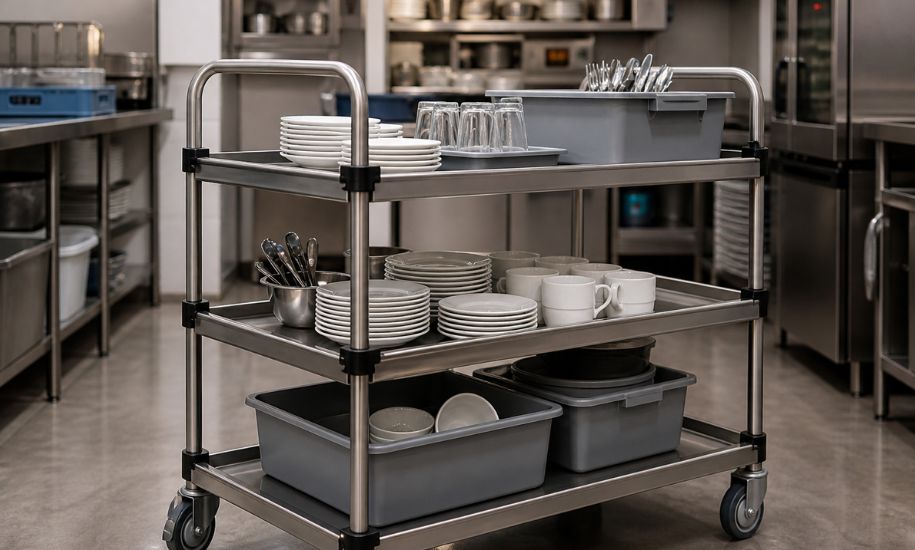
In restaurants, hotels, catering businesses, and other busy service environments, clearing tables efficiently is an important part of keeping operations running smoothly. Staff need to collect plates, glasses, cutlery, trays, and other items without making unnecessary trips between tables and the kitchen. This is where an afruimwagen can be useful.
The Dutch word afruimwagen generally refers to a trolley or cart used for clearing away items, particularly used dishes and tableware. The plural is afruimwagens. The word combines afruimen, meaning to clear away or remove items, with wagen, meaning cart or trolley.
Although designs vary considerably, an afruimwagen is essentially a practical transport solution designed to make clearing, collecting, and moving items easier. Depending on its construction, it may have several shelves, trays, containers, handles, and wheels.
These carts are particularly useful in hospitality and catering, but similar clearing trolleys can also be adapted for institutional, commercial, and service environments.
What Does Afruimwagen Mean?
Afruimwagen is a Dutch term that can be translated approximately as “clearing trolley,” “clearing cart,” or “dish-clearing trolley.”
The exact English translation depends on how the trolley is being used.
The word can be broken down into:
- Afruimen — to clear away, remove, or tidy away
- Wagen — cart, wagon, or trolley
Therefore, an afruimwagen is essentially a cart intended to help workers clear and transport items.
The plural form is:
Afruimwagens
This terminology is especially relevant in Dutch-speaking commercial and hospitality environments.
What Is an Afruimwagen Used For?
The main purpose of an afruimwagen is to transport multiple items efficiently instead of carrying them individually.
In a restaurant, for example, a server can place plates, glasses, bowls, and cutlery onto the trolley after clearing a table. The trolley can then be pushed to the appropriate service area.
Depending on the design, an afruimwagen may be used for:
- Collecting used dishes
- Transporting plates and bowls
- Moving glasses and cups
- Carrying cutlery
- Collecting trays
- Transporting food-service equipment
- Moving supplies between rooms
- Supporting catering operations
The exact application depends on the trolley’s dimensions, load capacity, material, and construction.
Why Are Afruimwagens Useful in Hospitality?
Restaurants and catering operations often involve repetitive movement.
A worker may otherwise need to carry several plates in their hands, return to the kitchen, and then walk back to the dining area. During busy periods, these repeated trips consume time and create additional physical strain.
An afruimwagen can consolidate several loads into one trip.
Faster Table Clearing
A trolley can allow employees to collect more items at once.
This can be especially helpful during:
- Lunch and dinner rushes
- Buffets
- Weddings
- Conferences
- Large catered events
- Hotel breakfast services
Better Organization
A trolley with multiple shelves or compartments can help separate different types of items.
For example, plates can be placed on one level while glasses and cutlery are handled separately.
Less Carrying
Instead of repeatedly lifting and carrying heavy stacks of dishes, workers can push the load.
This does not eliminate physical work, but it can reduce unnecessary carrying and improve workflow when the trolley is properly loaded.
Common Types of Afruimwagens
There is no single universal design for an afruimwagen. Manufacturers produce different configurations for different environments.
Open-Shelf Afruimwagens
These carts have open shelves and are among the simplest designs.
They are useful when workers need quick access to dishes, trays, or other items.
Advantages:
- Easy access
- Simple construction
- Easy loading and unloading
- Usually straightforward to clean
Potential drawback: Items remain visible and exposed, which may not be ideal in every environment.
Tray-Based Trolleys
Some clearing trolleys are designed to accommodate removable trays.
This can make it easier to organize dishes and transport them in a structured manner.
Tray-based designs can be particularly useful in buffet restaurants, institutional catering, and large dining operations.
Enclosed Trolleys
Enclosed designs provide greater protection for the contents.
Depending on the model, doors or panels may help conceal dishes, supplies, or waste containers.
These can be useful when appearance, hygiene, or controlled access is important.
Waste-Separation Trolleys
Some commercial clearing carts include separate containers for different waste streams.
For example, a trolley may provide dedicated spaces for:
- Food waste
- General waste
- Recyclable materials
- Used tableware
This can simplify clearing operations, although the actual waste-separation system should always follow the facility’s hygiene and waste-management procedures.
Materials Used in Afruimwagens
The material has a major influence on durability, weight, appearance, cleaning requirements, and suitability for a particular environment.
Stainless Steel
Stainless steel is a common choice in professional food-service environments.
Its advantages include:
- Good durability
- Resistance to corrosion under appropriate conditions
- Easy cleaning
- Professional appearance
- Suitability for demanding environments
However, stainless steel carts can be heavier than some plastic alternatives.
Plastic
Plastic trolleys can be lightweight and practical.
They may offer:
- Easy maneuverability
- Lower weight
- Resistance to many types of corrosion
- Relatively simple cleaning
- Good suitability for lighter-duty applications
The exact durability depends on the type and quality of plastic used.
Aluminum
Aluminum offers a combination of relatively low weight and strength.
It can be useful where staff need to move the trolley frequently and minimizing weight is important.
Mixed Materials
Many modern carts combine different materials.
For example, a trolley may have a metal frame, plastic shelves, rubber wheels, and polymer handles.
This approach allows manufacturers to optimize different parts of the cart for their particular function.
Important Features to Look For
If you are considering an afruimwagen for a restaurant, hotel, catering business, or institution, the number of shelves is only one consideration.
Load Capacity
Check how much weight the trolley is designed to carry.
A trolley that looks large does not necessarily have a high load capacity.
Overloading can make the cart difficult to control and may accelerate wear on wheels and joints.
Wheel Quality
The wheels have a major effect on everyday usability.
Look for wheels appropriate for the floor surfaces where the trolley will be used.
Important factors include:
- Smooth rolling
- Stability
- Appropriate wheel diameter
- Noise level
- Durability
- Swivel capability
Locking casters can also be useful when the trolley needs to remain stationary during loading or unloading.
Handle Design
A comfortable handle can make pushing easier, particularly when the cart is used repeatedly throughout a shift.
The handle should provide enough grip and allow the worker to maintain reasonable control.
Shelf Spacing
Consider what the trolley will carry.
A design suitable for plates may not be ideal for tall bottles, containers, or larger trays.
Cleaning Access
In hospitality, cleaning should be considered before purchasing.
Look for surfaces that are easy to wipe down and areas that do not unnecessarily trap food residue or moisture.
Afruimwagen Hygiene: What Matters in Practice?
A clearing trolley can make operations more organized, but the trolley itself needs appropriate cleaning.
This is particularly important when used for food-service items.
A practical cleaning routine may include:
- Remove dishes, waste, and other contents.
- Separate items according to the facility’s procedure.
- Clean visible food residue.
- Wash and sanitize surfaces according to workplace requirements.
- Pay attention to handles and frequently touched areas.
- Clean wheels when necessary.
- Allow surfaces to dry appropriately.
The exact cleaning chemicals and procedures should follow the manufacturer’s instructions and the applicable food-safety requirements.
One often-overlooked point is the wheels. Staff may focus on shelves and handles while forgetting that wheels collect dirt from the floor. In a professional environment, the cart’s cleanliness should be considered as a whole.
Afruimwagens and Ergonomics
Ergonomics is another reason businesses use transport carts.
Repeatedly carrying heavy or awkward loads can contribute to fatigue. A properly selected trolley allows much of the load to be transported by pushing or pulling rather than carrying.
However, a trolley is not automatically ergonomic.
Problems can arise if:
- It is overloaded
- Wheels are damaged
- The floor is uneven
- The handle is uncomfortable
- The cart is too large for the workspace
- Workers need to push it excessive distances
A well-maintained trolley with suitable wheels and an appropriate load can make routine movement considerably easier.
Afruimwagen vs. a Standard Service Trolley
The terms can overlap because commercial trolley designs vary, but their intended use can differ.
| Feature | Afruimwagen | General Service Trolley |
|---|---|---|
| Primary purpose | Clearing and transporting items | General transport/service |
| Typical environment | Restaurants, catering, hotels | Many industries |
| Dish handling | Often suitable | Depends on design |
| Shelving | Common | Varies |
| Waste collection | Some models | Depends on model |
| Hygiene requirements | Often high | Depends on application |
| Design flexibility | Application-specific | Broad |
It is therefore better to focus on what the trolley needs to do rather than choosing a product based solely on terminology.
How to Choose the Right Afruimwagen
Before buying, consider the actual workflow.
Step 1: Identify the Main Task
Will the trolley primarily carry:
- Dirty dishes?
- Clean tableware?
- Food trays?
- Waste?
- Catering equipment?
- General supplies?
The answer will influence the best design.
Step 2: Measure Your Workspace
Measure:
- Doorways
- Corridors
- Lift entrances
- Kitchen passages
- Storage areas
- Turning spaces
A trolley that works perfectly in an open dining hall may be frustrating in a narrow kitchen.
Step 3: Consider the Floor
Different floors create different demands.
Smooth commercial flooring may allow easy movement, while thresholds, uneven surfaces, or ramps require more attention to wheel size and trolley stability.
Step 4: Calculate the Typical Load
Do not select a trolley based only on its maximum advertised capacity.
Think about the normal working load and whether staff can push it comfortably when full.
Step 5: Consider Noise
In hotels, hospitals, and restaurants, excessive wheel noise can be disruptive.
Quiet casters may therefore be worth considering, particularly when carts are used near guests or patients.
Step 6: Think About Storage
Measure where the trolley will be parked when it is not being used.
This simple step can prevent a surprisingly common purchasing mistake: buying a cart that fits the workflow but has nowhere practical to be stored.
Common Mistakes When Using Afruimwagens
Overloading the Trolley
More capacity does not mean it should always be filled to the maximum.
An overloaded cart can become difficult to steer and may create safety problems.
Ignoring Wheel Maintenance
Damaged or dirty wheels can dramatically affect maneuverability.
Inspect them regularly and replace worn components when necessary.
Mixing Clean and Dirty Items
In food-service environments, clean and used tableware should be handled according to appropriate hygiene procedures.
A clearing trolley should not become an uncontrolled mixture of clean supplies, dirty dishes, and waste.
Choosing the Largest Model
Bigger is not always better.
A large trolley may hold more but become difficult to maneuver through doors, corridors, and crowded dining areas.
Focusing Only on Price
A very inexpensive trolley may cost more over time if its wheels, shelves, or frame wear out quickly.
Consider durability, maintenance, spare parts, and total operating cost.
Where Else Can Clearing Trolleys Be Used?
Although afruimwagens are strongly associated with clearing operations in hospitality, the basic trolley concept has broader applications.
Hotels
Hotels can use suitable service and clearing carts for breakfast areas, conferences, banquets, and other food-service operations.
Catering
Large events often require employees to move substantial quantities of tableware and supplies efficiently.
Schools and Institutions
Cafeterias and institutional dining facilities may use clearing carts to streamline dish collection.
Healthcare and Care Facilities
Similar trolley designs can be used for transporting meals, dishes, or supplies, although healthcare environments have additional hygiene and infection-control requirements.
Offices and Commercial Buildings
Depending on the design, service carts can also help transport supplies, refreshments, or equipment.
The important point is that not every trolley is suitable for every environment. Hygiene standards, load requirements, materials, and cleaning procedures should be considered before using one for a new purpose.
Are Afruimwagens Environmentally Friendly?
The environmental impact of an afruimwagen depends on several factors rather than simply the material from which it is made.
A durable trolley that remains in service for many years may avoid repeated replacement. Repairable components, replaceable wheels, and long-lasting construction can also contribute to a longer useful life.
Businesses can consider:
- Product durability
- Repairability
- Replaceable components
- Material efficiency
- Expected service life
- End-of-life recycling options
Another environmental benefit can come indirectly from improved workflow. If a trolley reduces unnecessary trips and helps staff move multiple loads efficiently, it may contribute to more efficient operations.
However, it would be inaccurate to claim that every afruimwagen automatically provides a significant environmental benefit.
The Future of Afruimwagens
The basic trolley is a mature piece of equipment, but its design can continue to evolve.
Potential developments include:
Better Ergonomics
Manufacturers can continue improving handles, wheel systems, weight distribution, and maneuverability.
More Sustainable Materials
Greater attention to recycled or recyclable materials may influence future commercial trolley designs.
Modular Components
Replaceable shelves, wheels, handles, and containers can make carts easier to maintain instead of replacing the entire unit.
Smarter Workflow Integration
In large facilities, transport equipment may increasingly be integrated into broader digital logistics systems.
However, features such as tracking, sensors, or autonomous movement should be evaluated as emerging possibilities or product-specific features, rather than assumed characteristics of every afruimwagen.
A Practical Example: Restaurant Dinner Service
Imagine a restaurant serving 150 guests during a busy evening.
Without a clearing trolley, a server may clear a few plates, carry them to the kitchen, return to the dining room, and repeat the process.
With an appropriately sized afruimwagen, the worker can consolidate multiple clearing tasks.
A sensible workflow might look like this:
Clear table → Sort items → Load trolley → Move to designated area → Unload → Clean trolley
The advantage is not that the trolley makes the work disappear. Instead, it reduces unnecessary carrying and helps organize repetitive movement.
This is where a simple piece of equipment can have a meaningful effect on day-to-day efficiency.
FAQ
What does afruimwagen mean?
Afruimwagen is a Dutch term generally referring to a trolley or cart used for clearing away and transporting items. It is particularly associated with clearing dishes and tableware in hospitality and catering environments. The plural form is afruimwagens.
What is an afruimwagen used for?
An afruimwagen is commonly used to collect and transport items such as plates, glasses, cutlery, trays, and other service equipment. Its main purpose is to reduce unnecessary carrying and make clearing operations more organized. The exact use depends on the trolley’s design.
Are afruimwagens only used in restaurants?
No. Although restaurants, hotels, and catering businesses are common users, similar clearing trolleys can also be useful in institutional dining, schools, care facilities, and other commercial environments. Suitability depends on the cart’s hygiene, load, material, and design requirements.
Which material is best for an afruimwagen?
There is no single best material for every application. Stainless steel is often attractive for demanding food-service environments because of its durability and cleanability, while plastic can provide a lighter option and aluminum can offer a balance between strength and weight. The best choice depends on workload, cleaning requirements, environment, and budget.
How do you clean an afruimwagen?
Remove all contents first, then clean the trolley according to the manufacturer’s instructions and the hygiene procedures of the workplace. Pay attention to shelves, handles, corners, containers, and wheels. Food-service operations should use cleaning and sanitation procedures appropriate to their applicable food-safety requirements.
What should I consider before buying an afruimwagen?
Consider the trolley’s intended use, load capacity, dimensions, shelf arrangement, wheel quality, maneuverability, cleaning requirements, noise level, durability, and available storage space. Most importantly, make sure the trolley fits the actual corridors, doors, floors, and workflow where it will be used.
Conclusion
Afruimwagens are practical clearing and transport trolleys designed to make repetitive movement easier and more organized. The Dutch term afruimwagen generally refers to a cart used for clearing away items, particularly dishes and tableware, while afruimwagens is the plural form.
Their greatest value is not complicated technology but practical workflow improvement. A well-designed trolley can allow staff to transport several items in one trip, reduce unnecessary carrying, improve organization, and support efficient service.
Choosing the right model requires more than looking at shelf count or price. Load capacity, wheel quality, dimensions, hygiene, maneuverability, noise, durability, and storage all matter.
For restaurants, hotels, caterers, and institutional food-service operations, the right afruimwagen can become a simple but highly useful part of the daily workflow. The best choice is ultimately the one that fits the environment, workload, and hygiene requirements rather than simply the largest or most feature-rich model.
