


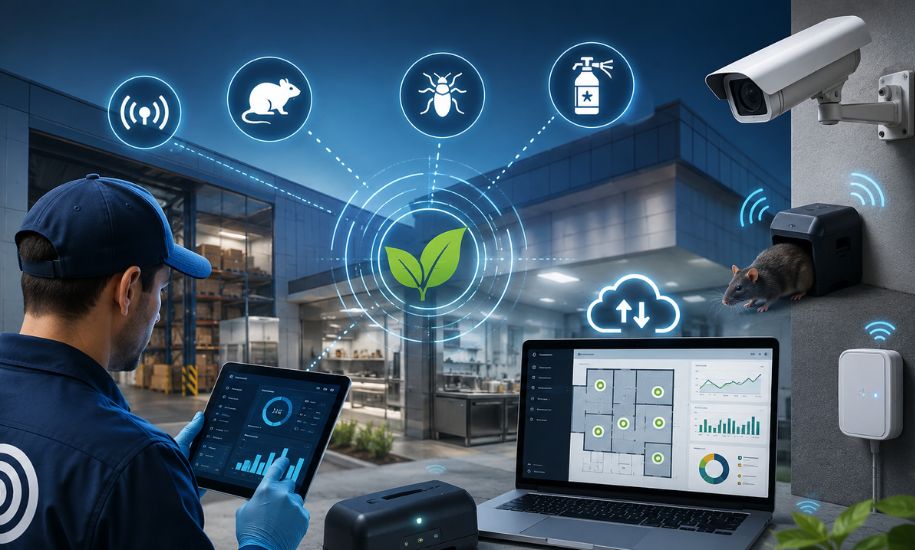
When pest control is discussed, most people imagine a technician visiting a building, looking for signs of rodents or insects, and applying a treatment when a problem is discovered. That traditional model still has an important role, but modern environmental sanitation is moving toward something much more proactive: continuous monitoring, connected devices, data analysis, and prevention.
This is where the story of Anticimex 3D Sanidad Ambiental and WiseCon becomes particularly interesting. Anticimex 3D Sanidad Ambiental, S.A.U. is the Spanish legal entity operating under the Anticimex brand, while WiseCon is closely connected to Anticimex’s development of digital pest-control technology. Anticimex acquired WiseCon’s remaining shares in 2017 and established the Anticimex Innovation Center in Denmark around its digital-pest-control expertise.
Today, Anticimex describes its SMART offering as a digitally enabled approach that combines biological knowledge, technology, sensors, intelligent traps, data, analytics, and professional service. The company says its SMART concept has grown to more than 600,000 installed devices worldwide, making the evolution from traditional pest control to connected prevention a significant part of its business strategy.
This guide explains what the strategy actually means, how the technology works, where WiseCon fits into Anticimex’s history, what “3D” means in the Spanish environmental-sanitation context, and why data-driven pest prevention is changing the industry.
What Is Anticimex 3D Sanidad Ambiental?
Anticimex 3D Sanidad Ambiental, S.A.U. is the legal name of Anticimex’s Spanish business entity. Anticimex provides pest-control and environmental-hygiene services designed for commercial, residential, public-sector, and other environments. The Spanish operation covers areas such as pest management, environmental hygiene, and related services.
The phrase “3D Sanidad Ambiental” is closely associated with the traditional three pillars of pest-control work in Spain:
- Desratización — rodent control
- Desinsectación — insect control
- Desinfección — disinfection
These activities address different environmental risks and require different methods. Rodent control, for example, is not approached in the same way as the management of flying insects, while disinfection involves a different set of procedures altogether.
The important development is that Anticimex increasingly combines conventional expertise with digital monitoring rather than treating technology as a replacement for professional pest-control knowledge.
Where Does WiseCon Fit Into Anticimex?
This is where many descriptions of the subject become confusing.
WiseCon was not simply a generic software platform. It was a Danish specialist company known for developing advanced electronic rodent traps and monitoring systems.
Anticimex initially acquired a 20% stake in WiseCon in January 2015. In April 2017, Anticimex acquired the remaining 80% and established the Anticimex Innovation Center in Denmark. The center became responsible for developing digital pest-control solutions for the wider Anticimex Group.
That history matters because it explains how Anticimex developed its current digital strategy.
The company did not simply add an app to conventional pest control. It progressively integrated:
- electronic trapping
- sensors
- remote monitoring
- connectivity
- data collection
- analytics
- biological expertise
- technician intervention
into a broader preventive service model.
Anticimex now identifies the Innovation Center, formerly WiseCon, as a major research and development hub for its digital pest-control technology.
What Is the Anticimex SMART Strategy?
The modern expression of this technology strategy is Anticimex SMART.
The idea is straightforward:
Detect pest activity as early as possible, collect useful data continuously, and enable technicians to respond before a small problem becomes a major infestation.
Instead of depending entirely on periodic physical inspections, connected devices can monitor designated risk areas continuously.
Anticimex says its SMART systems combine technology and analytics with biological knowledge and service expertise. Its systems can use intelligent traps and sensors to detect pest activity and transmit information to a central data environment.
This creates a fundamental change in the workflow.
Traditional model
Inspection → discovery → treatment → follow-up
Smart preventive model
Assessment → connected monitoring → detection → analysis → intervention → continuous improvement
The second model is much more data-driven.
How Anticimex SMART Works
A useful way to understand the system is to break it into three stages.
1. Analyze and plan
The process does not begin by randomly installing sensors.
Anticimex describes an initial assessment in which the site, documentation, critical areas, and relevant personnel are evaluated. The objective is to understand where pest activity could occur and determine an appropriate monitoring and control strategy.
This step is important because technology is only useful when deployed in the right places.
A sensor installed in an irrelevant location can generate little useful information. A strategically positioned sensor near a known pest pathway can provide much more valuable intelligence.
2. Install and connect
Once the risk areas are identified, sensors and smart traps are installed.
These devices communicate information to the company’s Smart data infrastructure. Depending on the pest and application, the technology can detect activity, monitor conditions, or report trap events.
The Spanish SMART portfolio includes different technologies for rodent and insect monitoring, as well as other environmental applications.
3. Analyze and act
The system is not intended to replace technicians.
Instead, the data helps technicians understand what is happening between physical visits.
When activity is detected, the information can trigger a faster response. Technicians can then inspect the situation, empty or relocate equipment where necessary, investigate the source, and modify the prevention strategy.
This creates a feedback loop:
Detection → data → professional assessment → action → new data
That feedback loop is one of the most important differences between smart pest management and a purely reactive approach.
What Technology Is Used?
The exact equipment depends on the environment and pest involved, but Anticimex’s SMART ecosystem includes connected traps and sensors.
For rodents, examples in the Spanish portfolio include Smart Box, Smart Pipe, Smart Eye, and Smart Catch. These products are designed for different environments and monitoring requirements.
Smart Box
Smart Box is designed for rodent control on the surface. Anticimex describes versions suitable for indoor and outdoor use and explains that sensors can detect movement and heat, activating the trapping mechanism. Captures are reported so technicians can respond and evaluate the results.
Smart Pipe
Smart Pipe is designed specifically for rodent control in sewer systems, placing the technology where rodents naturally move underground.
Smart Eye
Smart Eye is a compact sensor intended to detect and report movement, making it useful in narrow or difficult-to-access areas where rodents may travel.
Smart Sense
For insects, Anticimex’s Smart Sense technology is designed to detect activity from cockroaches and flying insects. The system uses temperature changes and non-toxic pheromone attraction together with adhesive capture surfaces and automatic reporting.
The practical lesson is that “smart pest control” is not one device. It is an ecosystem of devices, connectivity, data, and professional service.
Why 24/7 Monitoring Matters
A major weakness of periodic inspection is the time between visits.
Imagine a warehouse that receives a pest-control inspection once every month.
A rodent enters two days after the inspection.
For the next several weeks, the activity may go unnoticed unless an employee discovers evidence such as droppings, damaged packaging, unusual sounds, or a live animal.
With continuous monitoring, the same event can potentially be identified much earlier.
Anticimex describes SMART as providing around-the-clock surveillance and proactive response rather than relying solely on monthly or quarterly physical inspections.
This does not mean every problem is automatically eliminated.
It means the information gap becomes smaller.
That is a major operational advantage.
The Role of Data and Analytics
The real value of connected pest-control equipment is not simply that it can send an alert.
The bigger opportunity is what happens when many events are collected over time.
For example, a facility manager may discover that:
- activity consistently increases near one loading area
- a particular location has repeated rodent movement
- insect activity rises during certain periods
- one monitoring point repeatedly records activity
- a trap is receiving little activity and may be better positioned elsewhere
This turns pest management into a measurable process.
Anticimex says its SMART devices continuously send information to its data center, where data can be analyzed and managed to support proactive action. The company describes this as part of its use of Big Data in digital pest control.
A practical example
Consider a food-processing facility.
A conventional approach might reveal pest activity when a technician discovers evidence during an inspection.
A connected approach can identify repeated activity around a specific access point. The technician can investigate the physical cause, such as a gap, damaged door seal, drainage issue, or food source.
The important result is not simply “the trap caught a pest.”
The useful result is:
The data helped identify where and when the facility was vulnerable.
That is a much more valuable form of information.
Why This Approach Can Reduce Chemical Use
One of the strongest arguments for smart pest management is targeted intervention.
If pest activity is known precisely, professionals can focus their response on the relevant location and situation instead of automatically treating a larger area.
Anticimex positions SMART around reduced-impact and non-toxic digital solutions, particularly its smart trapping and monitoring technologies. The company says these systems can use data instead of relying unnecessarily on biocides.
However, an important distinction should be made:
Smart pest control does not mean that every pest-control situation requires zero chemicals.
Some infestations or environmental conditions may require conventional treatments.
The better interpretation is that digital monitoring can help professionals make more targeted decisions and potentially reduce unnecessary chemical intervention.
That is more realistic—and more useful—than claiming technology has completely replaced conventional pest control.
Environmental Sustainability and Smart Pest Control
Environmental impact has become an increasingly important consideration in pest management.
Businesses are under pressure to improve sustainability while also maintaining strict hygiene and safety standards.
Digital monitoring can contribute by:
- reducing unnecessary treatments
- targeting intervention more precisely
- identifying problems earlier
- reducing repeated inspection journeys
- improving documentation
- supporting preventive maintenance
Anticimex specifically presents its SMART technology as a way to combine pest protection with reduced environmental impact.
For municipalities, this can be particularly relevant.
Anticimex’s Spanish public-sector material describes digital pest monitoring as a tool for urban pest management and links it with reduced biocide use and fewer unnecessary technician journeys.
Which Industries Can Benefit?
Smart environmental sanitation is particularly valuable where pest activity can create significant financial, health, regulatory, or reputational consequences.
Food and beverage
Food facilities have little tolerance for pest contamination.
Continuous monitoring can help identify activity early and provide a stronger record of preventive controls.
Warehouses and logistics
Stored products and packaging can attract rodents and insects. Connected monitoring can help identify vulnerable locations without relying exclusively on routine inspections.
Pharmaceutical facilities
The cost of contamination or production interruption can be extremely high. Anticimex describes SMART solutions for pharmaceutical environments using digital traps, sensors, and cameras to monitor pest activity.
Hospitality
Hotels, restaurants, and other hospitality businesses depend heavily on hygiene and reputation.
Early detection can prevent a small pest issue from becoming a customer-facing problem.
Municipalities
Urban rodent management is particularly suited to connected monitoring because cities have large geographic areas, complex infrastructure, and sewer systems that are difficult to inspect manually.
Smart Sanitation Is More Than Pest Control
Another important development is the expansion from pest monitoring into broader environmental conditions.
Anticimex Spain also describes SMART technologies for areas such as indoor air quality and water management. Its Smart CAI sensor, for example, continuously measures parameters including CO₂, temperature, humidity, and ventilation-related conditions, with information stored in an online platform.
This suggests a broader direction for environmental sanitation:
from controlling individual pests to continuously monitoring environmental risk.
That shift could become increasingly important as buildings become more connected.
Anticimex’s Digital Strategy in Simple Terms
The company’s strategy can be understood through five connected layers.
Layer 1: Biological expertise
You need to understand pest behavior before technology can be deployed effectively.
Layer 2: Sensors and devices
Connected equipment gathers information from real-world environments.
Layer 3: Connectivity
Devices transmit events and measurements to centralized systems.
Layer 4: Data analysis
Collected information is transformed into patterns, alerts, and actionable insights.
Layer 5: Human intervention
Technicians use those insights to decide what should actually happen.
This final layer is critical.
The goal is not to automate human expertise away. The goal is to give professionals better information.
Common Misunderstandings About WiseCon and Anticimex
“WiseCon is Anticimex’s current public-facing brand.”
Not exactly.
WiseCon’s technology and expertise became part of Anticimex following the acquisition, and the former WiseCon operation became the Anticimex Innovation Center. Anticimex now presents SMART as its digital pest-control concept.
“SMART means no technicians are needed.”
Incorrect.
The system is designed to support technicians through continuous data and alerts. Physical inspections, analysis, equipment maintenance, relocation, and intervention remain important parts of the service.
“Digital pest control means every treatment is chemical-free.”
That is also too broad.
Anticimex promotes non-toxic SMART devices, but the wider service portfolio can include conventional pest-control methods where appropriate. The practical goal is more targeted and responsible pest management, not a simplistic promise that chemicals are never used.
“More sensors automatically mean better pest control.”
Not necessarily.
Poorly positioned sensors can generate limited value. Good pest management still begins with understanding the building, pest biology, risk points, sanitation conditions, access routes, and operational environment.
Technology works best when it is deployed strategically.
Three Important Insights Often Missed
1. The biggest innovation is not the trap—it is the feedback loop
A smart trap is useful because it produces information.
The real strategic advantage appears when that information changes technician behavior, site planning, trap placement, preventive recommendations, and future decisions.
That makes digital pest control a continuously improving system rather than a collection of gadgets.
2. Prevention depends on understanding the environment
A sensor can tell you that activity occurred.
It cannot automatically explain why.
The best results come when digital signals are combined with human knowledge of building design, sanitation, pest biology, supply chains, drainage, doors, waste handling, and maintenance.
In other words:
Data detects the symptom; expertise investigates the cause.
3. The strongest ROI may come from avoided problems
It is easy to measure the cost of installing sensors.
It is harder—but often more meaningful—to measure the cost of the infestation that never happened.
For a food producer, warehouse, hotel, or pharmaceutical company, preventing contamination, downtime, product loss, regulatory problems, or reputational damage can be more valuable than simply reducing the cost of a single pest-control visit.
That is why preventive pest control should be evaluated as a risk-management strategy, not just as an operational expense.
What the Future of Smart Environmental Sanitation Looks Like
The direction of the industry is clear: more connected devices, better data, stronger analytics, and increasingly preventive services.
Anticimex says its Innovation Center continues developing digital products and technologies, with its SMART ecosystem already deployed at large scale. The company reported more than 600,000 SMART device installations worldwide in 2025.
Future systems are likely to become better at:
- identifying unusual activity
- prioritizing high-risk locations
- predicting recurring patterns
- optimizing technician routes
- improving facility-level reporting
- integrating environmental sensors
- supporting sustainability reporting
- connecting pest data with wider building-management systems
The long-term opportunity is therefore much larger than replacing a paper inspection report with a digital dashboard.
It is about building a continuous environmental intelligence system.
Anticimex 3D Sanidad Ambiental and WiseCon: Final Verdict
The relationship between Anticimex 3D Sanidad Ambiental, WiseCon, and Anticimex SMART is best understood as a story of digital transformation.
Anticimex 3D Sanidad Ambiental is the Spanish legal entity operating under the Anticimex brand. WiseCon contributed important expertise in electronic rodent traps and digital monitoring, and after Anticimex acquired the remaining shares in 2017, that capability became part of the Anticimex Innovation Center.
The technology has since developed into the broader Anticimex SMART approach, combining sensors, intelligent traps, connectivity, data, analytics, biological expertise, and professional service.
The most important change is the move from reactive pest control to preventive, data-informed environmental management.
Instead of waiting for evidence of an infestation, organizations can continuously monitor risk. Instead of treating every situation in the same way, technicians can use real-world data to prioritize actions. And instead of viewing pest control only as an occasional maintenance expense, businesses can treat it as part of broader risk, hygiene, sustainability, and operational management.
That is ultimately what makes the Anticimex–WiseCon evolution significant: the technology is not valuable simply because it is digital. It is valuable because better information can lead to earlier decisions, more targeted interventions, and stronger prevention.
FAQ
What is Anticimex 3D Sanidad Ambiental?
Anticimex 3D Sanidad Ambiental, S.A.U. is the legal entity behind Anticimex’s Spanish operations. The company provides pest-control and environmental-hygiene services, including solutions for rodents, insects, and other environmental risks.
What was WiseCon?
WiseCon was a Danish specialist in electronic rodent traps and digital monitoring technology. Anticimex first acquired 20% of the company in 2015 and purchased the remaining 80% in 2017, after which the technology and expertise became part of the Anticimex Innovation Center.
What is Anticimex SMART?
Anticimex SMART is the company’s digitally enabled pest-control approach. It uses connected sensors, intelligent traps, data monitoring, and professional pest-control services to detect and respond to pest activity proactively rather than relying only on periodic inspections.
Does Anticimex SMART use pesticides?
SMART includes non-toxic monitoring and trapping technologies, and Anticimex promotes them as a way to reduce reliance on biocides. However, SMART should not be interpreted as meaning every Anticimex service is completely chemical-free; conventional treatments can still be used when appropriate.
How does smart pest control detect rodents?
Depending on the device, Anticimex systems can use sensors that detect movement, heat, or other activity associated with rodents. Connected devices can report activity to the monitoring system, allowing professionals to respond and adjust the pest-management strategy.
Why is data important in modern pest control?
Data provides information about where and when pest activity occurs. When analyzed alongside professional knowledge of the building and pest behavior, that information can help identify risk areas, improve trap placement, prioritize interventions, and strengthen preventive control.
