


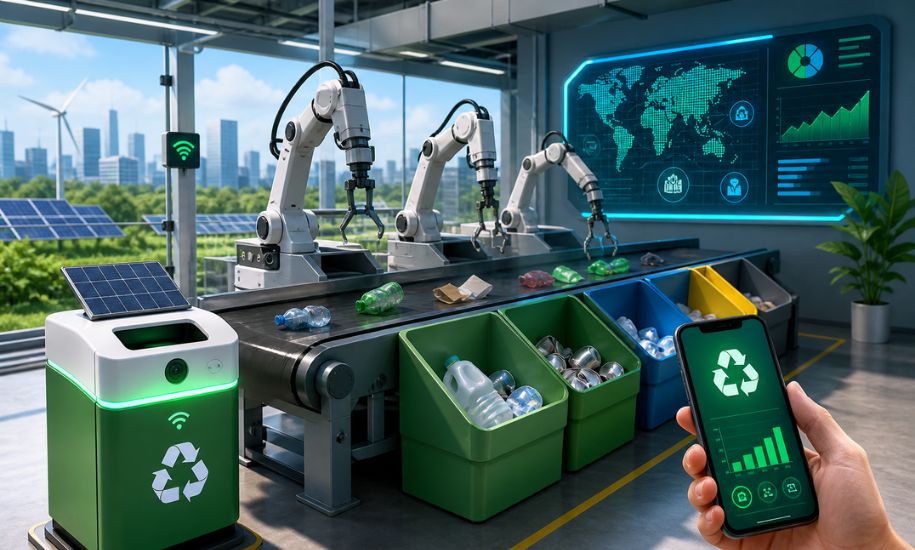
Recycling is often presented as something simple: separate your waste, place it in the correct container, and let the recycling system take care of the rest. In reality, effective recycling involves collection, sorting, contamination control, processing, education, and decisions about what materials can actually be recovered.
This is where the term MataRecycler has attracted attention online. However, there is an important point that is easy to miss: MataRecycler is not currently documented by its own website as a specific commercial AI-powered recycling machine or automated sorting system. Its official website describes MataRecycler primarily as a platform focused on recycling information, responsible waste management, sustainability, and environmental awareness.
At the same time, many articles use the name in connection with smart recycling concepts such as artificial intelligence, sensors, automated sorting, and data analytics. Those technologies are real and increasingly important in the recycling industry, but they should not automatically be presented as proprietary MataRecycler features without supporting evidence.
This distinction makes MataRecycler an interesting topic—not simply because of the name itself, but because it sits within a much larger shift toward technology-assisted recycling and more responsible resource management.
What Is MataRecycler?
MataRecycler is best understood, based on its own published information, as a recycling and sustainability-focused information platform.
Its stated purpose includes making information about recycling, waste management, sustainability, and environmentally responsible practices easier to understand. The platform says it provides educational content, recycling guides, sustainability insights, and awareness material for individuals and organizations.
That is different from describing MataRecycler as a physical recycling robot or a proven commercial waste-sorting system.
This distinction matters because several websites currently describe MataRecycler as an AI-powered system that uses:
- Artificial intelligence
- Computer vision
- Smart sensors
- Automated sorting
- Machine learning
- Data analytics
- Smart bins
These are legitimate technologies used or developed across the wider recycling industry. However, publicly available information does not provide enough primary evidence to attribute all of these capabilities directly to a specific MataRecycler product.
In simple terms
Think of the subject in two layers:
MataRecycler as documented:
A platform centered on recycling education, sustainability, responsible waste management, and environmental awareness.
Smart recycling as a broader technology field:
A real area of innovation involving AI, sensors, robotics, computer vision, automation, and data-driven waste management.
Keeping these two ideas separate gives readers a much more accurate understanding.
Why Is Smart Recycling Becoming Important?
The recycling industry faces problems that cannot always be solved simply by asking people to recycle more.
One major issue is contamination. When unsuitable materials are placed into recycling streams, they can reduce the quality and value of recovered materials.
There are also practical challenges involving:
- Manual sorting
- Collection efficiency
- Mixed materials
- Changing packaging designs
- Limited recycling infrastructure
- Consumer confusion
- Inconsistent local recycling rules
Technology can help address some of these problems, but technology is not a substitute for good collection systems, appropriate infrastructure, clear regulations, and informed consumers.
That is why modern recycling is increasingly moving toward a combination of human participation and technology-assisted decision-making.
How Does Modern Smart Recycling Work?
Although these technologies should not automatically be attributed to MataRecycler itself, they help explain the type of innovation frequently associated with the term.
1. Computer Vision
Computer-vision systems can analyze objects moving through a waste stream.
Depending on the system, cameras and machine-learning models may help identify characteristics such as:
- Shape
- Size
- Color
- Surface appearance
- Packaging type
- Object position
The system can then classify materials or objects for further sorting.
This is particularly useful in facilities where large quantities of waste need to be processed quickly.
2. Sensors
Sensors can provide information about waste and collection systems.
For example, a smart waste-management system may monitor:
- Container fill levels
- Weight
- Collection activity
- Environmental conditions
- Potential contamination
This information can help operators understand what is happening without relying entirely on manual inspection.
3. Automation and Robotics
Automated sorting equipment can move or separate materials after they have been identified.
A typical automated facility may combine conveyor belts, sensors, optical systems, mechanical equipment, and human workers.
The goal is not necessarily to eliminate people. Instead, automation can take over repetitive tasks while workers supervise equipment, handle exceptions, maintain machinery, and perform quality-control activities.
4. Data Analytics
Data can reveal patterns that are difficult to see through occasional manual inspections.
For example, an organization might discover that:
- Certain bins fill faster than others
- A particular location produces unusually high contamination
- Collection schedules are inefficient
- Certain materials are frequently discarded incorrectly
These insights can support better operational decisions.
Is MataRecycler an AI Recycling System?
This is one of the most important questions surrounding the term.
There is not enough publicly available primary evidence to confidently describe MataRecycler itself as a verified commercial AI-powered recycling system.
Some third-party articles make that claim, often describing AI, IoT sensors, smart bins, machine learning, and automated sorting. However, MataRecycler’s own About page describes the project primarily as an information and educational platform rather than providing detailed specifications for a proprietary recycling machine or robotics system.
That does not mean AI recycling technology is imaginary.
AI-powered waste recognition and automated sorting are genuine areas of technological development. The mistake is attributing every capability found in the wider industry to MataRecycler without evidence.
For readers researching the topic, this distinction is more useful than simply repeating claims found across multiple websites.
What Does MataRecycler Actually Focus On?
According to its published information, MataRecycler focuses on making recycling and sustainability information accessible and practical.
Its content areas include:
- Recycling methods
- Waste-management information
- Environmental awareness
- Reduce, reuse, and recycle practices
- Sustainability
- Educational resources
- Responsible environmental behavior
The platform also emphasizes making information understandable to readers from different backgrounds.
This educational role is important because recycling does not succeed through technology alone.
People still need to understand:
What should I recycle?
What should I reuse?
What belongs in general waste?
What materials require special disposal?
The answers can vary significantly between locations.
Why Local Recycling Rules Matter
One of the easiest mistakes in recycling content is assuming that the same rules apply everywhere.
They do not.
A material accepted in one municipality may not be accepted in another. Local facilities, collection contracts, processing capabilities, and regulations can all influence what residents are asked to recycle.
For that reason, a responsible recycling platform should be treated as a source of general education rather than a replacement for local waste-management instructions.
This is also consistent with MataRecycler’s own disclaimer, which advises readers to verify information and follow local recycling regulations and guidelines.
MataRecycler and the Circular Economy
The concept of the circular economy provides useful context for understanding why recycling technology matters.
A traditional linear model can be simplified as:
Take → Make → Use → Dispose
A circular approach aims to keep products and materials useful for longer:
Design → Use → Reuse → Repair → Recover → Recycle
Recycling is therefore only one part of the circular economy.
Other important strategies include:
- Reducing unnecessary consumption
- Designing products for durability
- Reusing products
- Repairing damaged items
- Recovering valuable materials
- Improving product design
- Reducing avoidable waste
This is an important practical insight: the best waste is often waste that was never created in the first place.
What Are the Benefits of Better Recycling Technology?
When properly designed and implemented, technology-assisted recycling can offer several potential advantages.
Better Material Identification
Automated recognition can help identify materials that might otherwise be missed during manual sorting.
Greater Operational Efficiency
Machines can process large volumes of material continuously, potentially improving throughput.
Better Data
Digital monitoring can provide information about waste flows, contamination, and collection patterns.
Improved Resource Recovery
Recovering more usable materials can reduce dependence on virgin resources.
Better Planning
Waste data can help organizations make more informed decisions about collection routes, infrastructure, and capacity.
However, these benefits depend heavily on implementation. A technology system does not automatically produce better recycling simply because it uses AI.
Environmental Benefits of Responsible Recycling
Whether technology is involved or not, effective recycling can contribute to broader environmental goals.
Potential benefits include:
- Reducing the amount of waste sent to disposal
- Conserving materials
- Supporting resource recovery
- Reducing demand for some virgin resources
- Encouraging more responsible consumption
- Improving awareness of waste generation
The actual environmental benefit varies by material, recycling process, transportation requirements, energy use, and local infrastructure.
This is another reason to avoid simplistic claims such as “all recycling is automatically environmentally beneficial.” The complete life cycle matters.
Economic and Business Relevance
Waste is not only an environmental issue. It is also an operational and economic issue.
Businesses can lose money through:
- Poor waste segregation
- Inefficient collection
- Material contamination
- Unnecessary disposal
- Lost opportunities to recover valuable materials
Better waste management can potentially reduce these inefficiencies.
For larger organizations, digital monitoring may also make it easier to measure waste streams and identify areas where material use can be reduced.
The strongest sustainability programs therefore connect environmental goals with practical business outcomes rather than treating recycling as a separate activity.
How Individuals Can Apply the Idea
You do not need an AI recycling system to make a meaningful difference.
Start with simple habits.
1. Learn Your Local Rules
Check which materials your local recycling service actually accepts.
2. Keep Recyclables Clean Enough
Food residue and liquids can contaminate recyclable materials.
3. Avoid “Wishcycling”
Wishcycling means placing something in the recycling bin because you hope it can be recycled, even when you are unsure.
When uncertain, check local guidance rather than guessing.
4. Reduce Before Recycling
Buying less unnecessary packaging can have a greater impact than simply becoming better at sorting it afterward.
5. Reuse When Practical
A product that can be safely reused does not necessarily need to become waste immediately.
6. Handle Special Waste Separately
Batteries, electronics, chemicals, and other potentially hazardous materials may require dedicated collection systems.
Never assume that everything belongs in the normal recycling bin.
MataRecycler for Businesses and Communities
A recycling-focused information platform can be particularly useful for education.
Businesses and communities can use recycling resources to:
- Train employees
- Improve waste awareness
- Explain recycling rules
- Encourage responsible disposal
- Develop sustainability initiatives
- Communicate environmental goals
For larger organizations, these educational efforts can be combined with actual waste audits and measurable targets.
For example, instead of simply saying “we want to recycle more,” an organization could track:
Current contamination rate → target contamination rate → progress over time
That turns a general sustainability goal into something measurable.
Challenges of Smart Recycling
Technology has limitations.
Cost
Advanced sorting equipment, sensors, software, and maintenance can require substantial investment.
Infrastructure
A smart system cannot work effectively if collection and processing infrastructure is inadequate.
Data Quality
AI models depend on good training and operational data. Unusual, damaged, or newly introduced materials can create classification challenges.
Maintenance
Sensors, cameras, mechanical systems, and software all require ongoing maintenance.
Human Behavior
Even the most advanced system cannot completely solve poor disposal habits.
Local Differences
Recycling systems differ by country, region, and municipality. A technology designed for one waste stream may not work identically elsewhere.
These limitations demonstrate why smart recycling should be viewed as part of a larger waste-management system rather than a magic solution.
The Future of Recycling Technology
The future of recycling is likely to involve increasing cooperation between people, machines, data, and better material design.
Potential developments include:
- More sophisticated computer vision
- Improved robotic sorting
- Better material identification
- Automated quality control
- Smarter collection planning
- More detailed waste analytics
- Digital sustainability reporting
- Better product traceability
At the same time, policy and product design will remain crucial.
If manufacturers design packaging that is difficult or impossible to recycle, better sorting technology can only solve part of the problem.
The long-term objective should therefore be broader than simply sorting waste faster. It should be about designing systems that create less waste and recover more value from materials that are already in circulation.
How to Evaluate Claims About MataRecycler
Because the term appears in many online articles with different descriptions, readers should check several things before accepting a technological claim.
Ask:
- Does the official source describe the technology?
- Is there a documented product or service?
- Are technical specifications publicly available?
- Are independent demonstrations available?
- Are performance figures supported by evidence?
- Is the company, organization, or project clearly identified?
This approach is useful beyond MataRecycler. Sustainability is an area where impressive technological language can easily sound more established than it actually is.
A claim repeated across ten blogs is not necessarily ten independent confirmations.
FAQ
What is MataRecycler?
MataRecycler is presented by its own website primarily as a platform focused on recycling information, responsible waste management, sustainability, and environmental awareness. It provides educational material designed to help individuals and organizations understand recycling and sustainable practices. Claims that it is a specific commercial AI recycling machine or automated sorting system are not clearly established by its primary website.
Is MataRecycler really an AI-powered recycling system?
There are third-party articles describing MataRecycler as an AI-powered recycling technology using sensors, machine learning, computer vision, and automation. However, these claims should be treated separately from what MataRecycler’s own website currently documents. AI-powered recycling itself is a real technology field, but that does not prove that every described capability belongs to MataRecycler.
How does AI help with recycling?
AI can help analyze images or sensor information to classify waste materials and support automated sorting. It can also be combined with data analytics to identify contamination patterns and operational inefficiencies. The effectiveness depends on the quality of the system, waste stream, training data, equipment, and local infrastructure.
What is the main goal of MataRecycler?
The platform’s stated goal is to promote responsible recycling, sustainability, environmental awareness, and accessible information about waste management. Its published material emphasizes education and helping people make more informed environmental decisions.
Can MataRecycler replace traditional recycling systems?
There is currently no strong primary evidence that MataRecycler is a complete replacement for conventional recycling infrastructure. Recycling still requires collection, sorting, processing facilities, markets for recovered materials, regulation, and consumer participation. Digital information and smart technology can support these systems, but they do not eliminate the need for the underlying infrastructure.
Why is smart recycling important?
Smart recycling can potentially improve material identification, collection efficiency, monitoring, and decision-making. It is especially useful when large quantities of waste must be processed consistently. However, technology works best when combined with good recycling policy, infrastructure, product design, and public participation.
Final Thoughts
MataRecycler is an interesting example of how recycling and sustainability have become increasingly connected with digital technology. However, it is important to separate what is documented about MataRecycler itself from what is possible through modern smart-recycling technology.
Based on its own published information, MataRecycler is primarily an educational and informational platform focused on recycling, sustainability, responsible waste management, and environmental awareness.
AI, computer vision, sensors, robotics, and data analytics are genuinely transforming parts of the recycling industry, but those technologies should not automatically be presented as proprietary MataRecycler features without reliable evidence.
Ultimately, the future of recycling will depend on more than one platform or technology. It will require better product design, smarter collection systems, effective sorting, responsible consumer behavior, strong local infrastructure, and policies that keep valuable materials in circulation.
The most useful way to think about MataRecycler, therefore, is not as a magical replacement for recycling as we know it, but as part of a broader conversation about how better information, responsible behavior, and emerging technology can work together to reduce waste and build a more sustainable future.
