


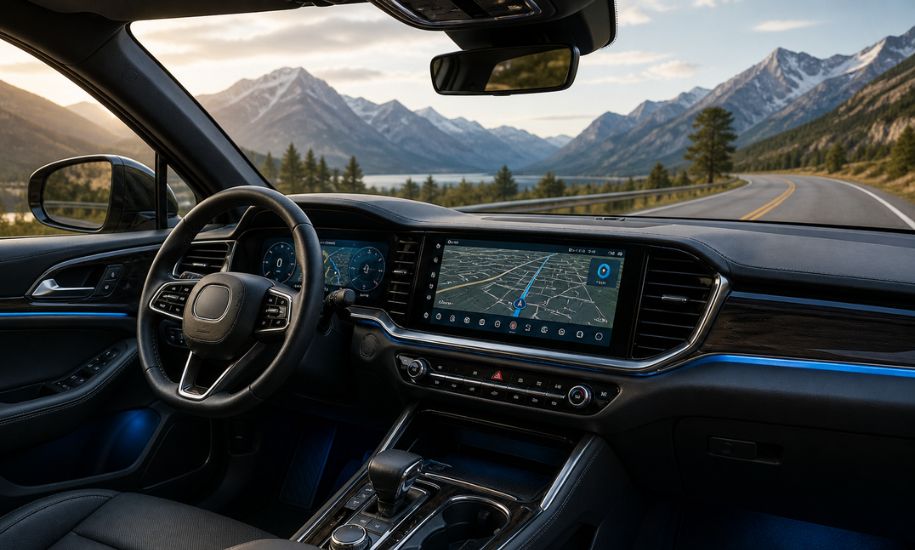
The modern SUV is becoming less like a traditional car dashboard and more like a connected digital environment. Digital instrument clusters, large infotainment screens, cloud-connected navigation, voice assistants, smartphone integration, and augmented-reality guidance are changing how drivers interact with their vehicles.
One feature attracting particular attention is navigation displayed within the digital cockpit. Instead of keeping route information exclusively on the center touchscreen, compatible SUVs can place turn-by-turn directions, maps, lane guidance, and other driving information directly in the driver’s view.
For buyers, however, the phrase “digital cockpit” can be confusing. Different manufacturers use different names for similar technologies, and navigation availability can depend on the model year, trim level, market, software package, and optional equipment.
This guide explains what SUVs with navigation in a digital cockpit actually offer, what features matter most, which models are worth considering, and what buyers should check before purchasing.
What Is a Digital Cockpit in an SUV?
A digital cockpit is an electronic driver-information environment that replaces or supplements conventional analog gauges with digital displays.
A typical modern SUV may combine:
- A digital instrument cluster behind the steering wheel
- A central infotainment touchscreen
- Integrated navigation
- Smartphone connectivity
- Voice controls
- A head-up display
- Driver-assistance information
- Vehicle settings and warnings
The exact configuration varies considerably between manufacturers.
Some systems keep the instrument display relatively simple, showing speed, range, driver-assistance information, and a small navigation panel. More advanced systems can display a large map or detailed route guidance across much of the driver’s digital cluster.
What Does “Navigation in the Digital Cockpit” Mean?
Navigation in the digital cockpit means that route information is presented through the driver’s display system rather than only on the central infotainment screen.
Depending on the SUV, this may include:
- Turn-by-turn arrows
- Map views
- Upcoming street names
- Lane guidance
- Distance to the next turn
- Speed-limit information
- Traffic information
- Route changes
- Points of interest
Some vehicles can also project navigation information onto the windshield through a head-up display (HUD).
This can be useful because the driver does not always need to look toward the center console to understand the next navigation instruction.
Why Integrated Navigation Matters
A navigation system is most useful when it delivers the right information without unnecessarily competing for the driver’s attention.
A digital cockpit can organize navigation alongside essential driving information.
For example, a driver may see:
Current speed → speed limit → next turn → distance → lane guidance
without completely abandoning the instrument cluster.
The benefit is not that a digital display automatically makes driving safer. Driver distraction depends on the entire interface and how it is used. A poorly designed system can still demand too much attention.
The best systems therefore aim for clear information at the right time.
Important Features to Look For
Not every digital cockpit is equally capable. If integrated navigation is important to you, look for the following features.
1. Digital Instrument Cluster
The instrument cluster should provide enough screen area and flexibility to display navigation without hiding essential driving information.
Some systems allow different layouts, while others offer only limited customization.
2. Full Map Display
A basic navigation system may show only arrows and distances. More sophisticated systems can display an actual map inside the driver display.
This can be particularly useful at complex intersections.
3. Turn-by-Turn Guidance
Turn-by-turn instructions provide information such as:
- Turn direction
- Street name
- Distance
- Lane guidance
- Upcoming junctions
This is often more useful while driving than a constantly visible full map.
4. Real-Time Traffic
Connected navigation can use traffic information to identify congestion and suggest alternative routes.
The availability and accuracy of traffic information can depend on the navigation provider, subscription, connectivity, and region.
5. Voice Navigation
Voice controls allow drivers to enter destinations without manually typing while driving.
The system should ideally understand natural commands and provide useful confirmation before starting a route.
6. Apple CarPlay and Android Auto
Smartphone integration remains important because many drivers prefer Google Maps, Waze, Apple Maps, or another navigation service over the vehicle’s built-in system.
However, the exact way smartphone navigation appears in the instrument cluster varies by vehicle and software system.
7. Head-Up Display
A HUD can project navigation instructions, speed information, or other data into the driver’s field of view.
Premium SUVs increasingly offer sophisticated HUD systems, although availability often depends on trim or an optional package.
8. Augmented-Reality Navigation
AR navigation adds visual guidance to a camera image or navigation environment.
For example, an arrow may appear to point toward the correct road or exit.
It can be particularly helpful in complicated urban environments, but buyers should test the system themselves because the usefulness of AR varies by implementation.
Best SUVs With Digital Cockpit Navigation
There is no single “best” SUV for everyone. The right choice depends on budget, vehicle size, software preferences, comfort, and how important navigation technology is to you.
The following models illustrate different approaches to digital cockpit technology. Features can vary by market and model year, so buyers should verify the specification of the exact vehicle they are considering.
Audi Q8
The Audi Q8 is a strong example of a premium SUV with an advanced digital cockpit.
Audi’s Virtual Cockpit concept places a configurable digital instrument display in front of the driver. Depending on the configuration, navigation information can be integrated into this display alongside vehicle information.
The Q8 is particularly attractive to buyers who want:
- Premium interior technology
- Customizable driver information
- Integrated navigation
- A sophisticated infotainment environment
- Strong long-distance comfort
Its main limitation is price: advanced cockpit technology is generally found within a premium-vehicle ownership experience.
Audi Q7
The Audi Q7 combines a large SUV body with Audi’s digital cockpit technology.
Its appeal comes from the combination of practicality and premium technology. Navigation information can be presented through the driver display while additional map and route information remains available through the center infotainment system.
For families, the Q7 is worth considering when interior space is as important as digital technology.
Hyundai Tucson
The Hyundai Tucson demonstrates how digital cockpit technology has moved beyond the luxury segment.
Depending on market and trim, Tucson models can offer digital instrumentation, connected navigation, smartphone integration, voice functionality, and advanced driver-assistance features.
Its appeal is that buyers can obtain many modern digital features without necessarily moving into the price range of a luxury SUV.
However, specifications differ significantly by country and trim, so buyers should check the local equipment list rather than assuming every Tucson includes every feature.
Kia Sportage
The Kia Sportage has embraced the large-screen approach to the modern dashboard.
Higher-specification versions can combine a digital driver display with a large central screen, creating an integrated digital environment.
Its strengths include:
- Modern interior design
- Large displays
- Connected features
- Smartphone integration
- Available navigation technology
The Sportage is particularly interesting for buyers who want a technology-focused cabin without automatically moving into the premium segment.
Ford Explorer
The Ford Explorer provides another example of the increasingly software-focused SUV interior.
Depending on model year and specification, Explorer models can offer digital instrumentation, connected navigation, voice interaction, smartphone connectivity, and a large infotainment display.
The Explorer’s biggest advantage is the combination of technology with family-oriented practicality.
Buyers should pay close attention to model-year differences because Ford’s infotainment and display hardware have evolved over time.
Range Rover
Range Rover sits at the luxury end of the SUV market and places considerable emphasis on digital technology.
Depending on specification, drivers can benefit from advanced navigation, digital displays, connectivity, and available head-up-display technology.
The appeal is not simply the number of screens. Range Rover combines digital features with a premium cabin, comfort, and extensive vehicle customization.
The drawback is the associated purchase and ownership cost.
Mercedes-Benz EQS SUV
The Mercedes-Benz EQS SUV represents a more software-intensive interpretation of the luxury digital cockpit.
Depending on configuration, Mercedes-Benz’s digital ecosystem can combine a large central display, digital driver information, navigation, voice interaction, and other connected services.
Some configurations feature the MBUX Hyperscreen, which stretches across much of the dashboard and creates a highly screen-focused interior.
The EQS SUV is particularly relevant for buyers interested in the intersection of electric vehicles, luxury, connectivity, and advanced digital interfaces.
Digital Cockpit vs Infotainment Screen
These two terms are often confused.
Digital Cockpit
The digital cockpit primarily refers to the driver’s information environment.
It can include:
- Speed
- RPM or power information
- Navigation
- Driver-assistance status
- Vehicle warnings
- Range
- Trip information
Infotainment System
The infotainment system generally controls:
- Navigation
- Music
- Phone calls
- Apps
- Vehicle settings
- Connectivity
The two systems increasingly communicate with each other.
That integration is what makes modern digital cockpits more useful than simply replacing analog gauges with a screen.
Built-In Navigation vs Smartphone Navigation
One of the most important purchasing decisions is whether you actually need built-in navigation.
Built-In Navigation
Advantages include:
- Integrated vehicle interface
- Navigation information designed for the car
- Potential integration with the digital instrument cluster
- Vehicle-specific information
- Often available without connecting a phone
Potential disadvantages include:
- Map updates
- Subscription requirements on some systems
- Different user interface
- Some systems may be less familiar than smartphone apps
Smartphone Navigation
Services such as Google Maps, Apple Maps, and Waze are familiar to many drivers.
Advantages include:
- Familiar interface
- Frequently updated maps
- Large database of destinations
- Personalized information
- Traffic and location features
However, smartphone navigation does not necessarily appear fully inside the vehicle’s digital instrument cluster. This depends on the car, operating system, connectivity implementation, and supported software.
What Is Augmented-Reality Navigation?
Augmented-reality navigation is one of the more advanced developments in automotive interfaces.
Instead of presenting navigation as a conventional map, the system can combine route guidance with a visual representation of the road environment.
A navigation arrow might appear over the appropriate road or turn.
The objective is to make instructions easier to interpret, particularly when several roads or exits are close together.
AR navigation should still be treated as an assistance feature rather than something that eliminates the need for driver attention.
The Rise of Software-Defined Vehicles
One of the biggest changes in the automotive industry is the growing importance of software.
Traditionally, a vehicle’s features were largely determined when it left the factory. Modern connected vehicles can receive software updates that change or improve certain functions.
This can affect:
- Navigation
- Voice assistants
- Infotainment
- Digital displays
- Driver-assistance systems
- Connectivity
This transition means that buyers should consider not only the hardware in an SUV but also how the manufacturer handles software updates and long-term support.
AI and the Future of Navigation
Artificial intelligence is increasingly influencing automotive software.
Future navigation systems can become more conversational and personalized.
Instead of saying:
“Navigate to 25 Main Street.”
A driver might eventually be able to make a more natural request such as:
“Find a quiet restaurant near our route with parking.”
The system could potentially combine navigation, preferences, traffic, location data, and vehicle information to produce a more useful recommendation.
However, AI-powered automotive features also raise important questions around privacy, reliability, connectivity, and driver distraction.
Advantages of SUVs With Digital Cockpit Navigation
The main benefits include:
Better Information Organization
Important driving information can be displayed in one place.
Convenient Route Guidance
Drivers can receive directions without relying entirely on the center screen.
Greater Customization
Digital displays can provide different layouts depending on the driver’s preferences.
Strong Connectivity
Modern systems can connect navigation, smartphones, cloud services, and vehicle data.
More Advanced Driver Assistance
Navigation information can sometimes work alongside driver-assistance systems to provide contextual information.
Potential Drawbacks
Digital cockpits are not perfect.
Higher Vehicle Prices
Advanced displays and software can increase the cost of higher-specification vehicles.
Software Complexity
More features can mean more settings, menus, and potential software problems.
Subscription Services
Some connected navigation and digital services may require subscriptions after an included period.
Distraction Risk
A larger screen does not automatically mean a better driving experience. Too much information can become distracting.
Software Dependence
Connected systems may rely on internet connectivity, cloud services, smartphone compatibility, or manufacturer support.
How to Choose the Right SUV
Before buying an SUV with digital cockpit navigation, consider these questions.
Is Navigation Visible Behind the Steering Wheel?
Do not assume that a vehicle with a digital instrument cluster can display a full navigation map there.
Is It Standard or Optional?
Check whether the feature is included on the specific trim.
Does Smartphone Navigation Appear in the Cluster?
This can be different from simply having Apple CarPlay or Android Auto on the center display.
Is a Head-Up Display Available?
If minimizing glances away from the road is important, HUD technology may be worth considering.
Are Updates Included?
Check how long map and connected-service updates are provided.
Does the System Require a Subscription?
Some connected features may have ongoing costs.
How Easy Is the System to Use?
A test drive is extremely valuable. Try entering a destination, changing the route, adjusting the display, and using voice commands.
Digital Cockpit SUV Buying Checklist
Before purchasing, check:
- Digital instrument cluster
- Navigation in driver display
- Full-map option
- Turn-by-turn guidance
- Real-time traffic
- Voice destination entry
- Apple CarPlay
- Android Auto
- Head-up display
- Augmented-reality navigation
- Over-the-air updates
- Connected-service subscription terms
- Local availability of navigation features
This checklist can prevent a common mistake: buying a vehicle because it has a “digital cockpit” without confirming exactly what that cockpit can display.
Are Digital Cockpits Worth It?
For many drivers, yes—but the answer depends on how the technology is implemented.
A digital cockpit is most valuable when it improves access to information without making the driving experience unnecessarily complicated.
For frequent travelers, commuters, and drivers who regularly use navigation, having route information integrated into the driver’s display can be genuinely useful.
For someone who rarely uses navigation, paying a significant premium for advanced cockpit technology may not make financial sense.
The key is to evaluate the actual features, not simply the marketing terminology.
The Future of SUVs With Navigation in Digital Cockpits
Digital cockpit technology is likely to become increasingly integrated with the rest of the vehicle.
Future systems may combine:
- AI-powered voice assistants
- Predictive navigation
- More advanced AR displays
- Personalized driver profiles
- Cloud-connected services
- Improved EV route planning
- More sophisticated HUD systems
- Advanced driver-assistance information
Electric SUVs will be especially dependent on sophisticated navigation because route planning can involve battery state, charging locations, charging speeds, traffic, weather, and estimated energy consumption.
As vehicles become increasingly software-defined, navigation will likely become more than a simple map. It may become a central part of the vehicle’s broader decision-support system.
Final Thoughts
SUVs with navigation in digital cockpits are changing the way drivers interact with vehicle information. Instead of separating speed, navigation, connectivity, and driver assistance into disconnected systems, modern vehicles increasingly bring these functions together through digital displays.
Models such as the Audi Q8, Audi Q7, Hyundai Tucson, Kia Sportage, Ford Explorer, Range Rover, and Mercedes-Benz EQS SUV demonstrate different approaches to this technology across premium, mainstream, family, luxury, and electric SUV segments.
However, buyers should look beyond phrases such as “digital cockpit,” “connected navigation,” or “smart dashboard.” The most important questions are whether navigation actually appears in the driver’s display, whether the feature is standard or optional, how smartphone navigation is supported, whether a head-up display is available, and whether connected features require subscriptions.
The best digital cockpit is not necessarily the one with the biggest screen. It is the one that gives the driver the right information, in the right place, at the right time—without unnecessary distraction.
As automotive software continues to evolve, navigation will become increasingly connected with AI, cloud services, electric-vehicle route planning, and advanced driver assistance. The SUV dashboard of the future may therefore be less about traditional gauges and more about creating an intelligent, personalized, and carefully designed interface between the driver and the road.
