


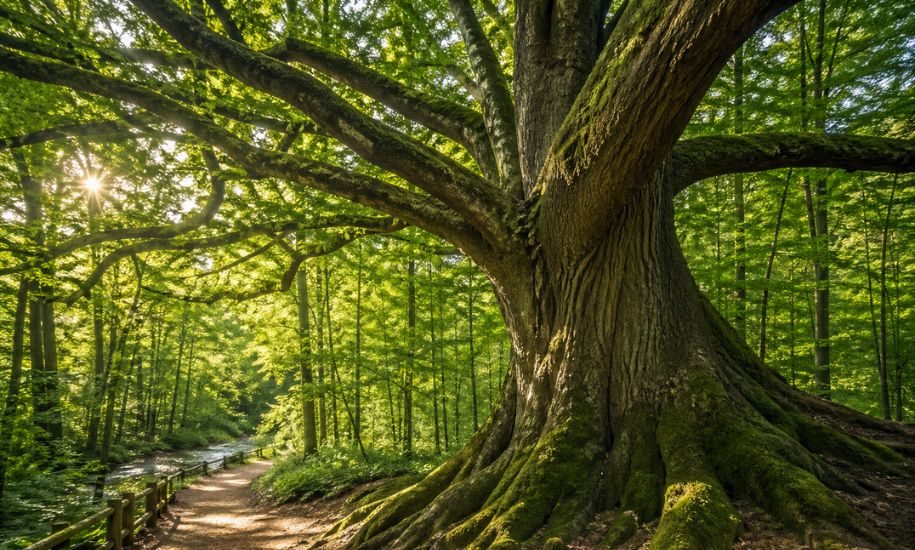
If you’re searching for champion trees near Lewis Center Ohio, you’re looking for more than simply the biggest trees you can see from a trail. Champion-tree programs use standardized measurements to identify exceptional specimens of a particular species, while local parks provide the places where you can actually experience mature forests and impressive individual trees.
Lewis Center is an especially interesting starting point because it sits close to several natural areas in Delaware County and the greater Columbus region. Highbanks Metro Park, for example, protects mature forest, river habitat and a state nature preserve, while Preservation Parks of Delaware County manages several natural areas with mature Ohio woodlands.
One important distinction is worth making at the beginning: seeing a huge tree does not necessarily mean you have found an official champion. Champion status depends on species identification, measurements, verification and the particular champion-tree registry being used.
With that in mind, this guide explains what champion trees are, where to look around Lewis Center, how the measurement system works, and how to responsibly search for your own potential tree giant.
What Is a Champion Tree?
A champion tree is an exceptionally large example of its species that ranks at or near the top of a recognized big-tree program.
American Forests, which operates the National Champion Tree program, evaluates eligible trees using three principal measurements:
- Trunk circumference
- Tree height
- Average crown spread
The standard scoring formula is:
Circumference in inches + height in feet + ¼ average crown spread in feet = total points.
This means that a tree does not have to be the tallest specimen to score extremely well. A tree with an enormous trunk and broad canopy can outperform a taller but slimmer tree.
Champion Tree vs. Big Tree
These terms are sometimes used interchangeably in casual conversation, but there is an important difference.
A big tree is simply a tree that looks exceptionally large.
A champion tree has been evaluated according to a defined program’s rules and compared with other specimens of the same species.
So if you encounter an enormous sycamore at a park near Lewis Center, it is better to call it a potential champion or impressive specimen unless its official status has been verified.
Why Lewis Center Is a Great Starting Point
Lewis Center sits in an area with a useful combination of river corridors, mature woodland, ravines and protected natural areas.
The surrounding landscape includes the Olentangy River and several conservation-focused parks. These environments can support large native trees, particularly where trees have had decades to grow without major disturbance.
Highbanks is particularly notable. The park covers roughly 1,200 acres and includes mature oak-hickory, beech-maple and mixed floodplain communities. It also contains the 206-acre Edward F. Hutchins State Nature Preserve.
That combination makes the area excellent for looking for impressive mature trees, even when a particular specimen is not an officially designated champion.
Best Places to Look for Champion-Size Trees Near Lewis Center
1. Highbanks Metro Park
Highbanks Metro Park is one of the strongest places to begin a tree-hunting trip because it is directly in Lewis Center and contains extensive mature forest.
The park is named for its dramatic shale bluff overlooking the Olentangy State Scenic River. Its landscape includes ravines, river-bottom habitat, mature woodland and a protected state nature preserve.
What Makes Highbanks Special?
The park’s forest communities include:
- Oak-hickory woodland
- Beech-maple forest
- Mixed floodplain forest
- River-associated vegetation
Metro Parks also identifies Highbanks as home to a national champion sycamore, making this location particularly relevant to anyone researching champion trees.
Rather than wandering off established trails to search for trees, use the designated trail system and park information. The Overlook Trail, Dripping Rock Trail, Scenic River Trail and Sycamore Trail provide different ways to experience the park’s woodland and river environments.
Best Approach
For a first visit, combine a trail walk with deliberate tree spotting. Look for unusually thick trunks, broad crowns and mature trees growing in favorable locations such as river-bottom areas.
Remember that the largest-looking tree is not necessarily the official champion.
2. Preservation Parks of Delaware County
The network managed by Preservation Parks of Delaware County is another excellent option for people interested in mature native trees and natural landscapes.
The system includes numerous parks and trails throughout the county, including Shale Hollow Park, Sycamore Run Park, McCammon Creek Park and other natural areas.
These parks are useful for casual tree exploration because they combine accessible trails with protected woodland and wildlife habitat.
Shale Hollow Park
Shale Hollow is named for the tributary valley and geological features associated with the area. Its natural setting makes it a good place to observe native woodland species and compare tree shapes, bark and canopy structure.
McCammon Creek Park
McCammon Creek Park is particularly convenient for Lewis Center visitors because it is located on Bale Kenyon Road in Lewis Center. Its trail system includes wooded and creek-associated areas, providing another opportunity to observe mature trees.
3. Char-Mar Ridge Park
Another Delaware County option is Char-Mar Ridge Park.
The park’s Glacier Ridge Trail passes through mature woods, forested ravines and wooded wetlands. The dominant tree types include oak, beech, maple and hickory. The park also has tree-identification signs, making it particularly useful for visitors who want to improve their tree-identification skills while searching for large specimens.
This is a good example of why tree hunting does not have to mean searching for a confirmed champion. A walk through mature woodland can help you learn which species naturally develop the size and form associated with champion-tree candidates.
What Tree Species Should You Look For?
Central Ohio supports a diverse collection of native hardwoods.
Some species worth watching for include:
American Sycamore
American sycamore (Platanus occidentalis) is one of the most recognizable giant trees in Ohio.
Its characteristic mottled bark and tendency to develop very large trunks make it an obvious candidate whenever you’re looking for exceptionally large specimens.
Highbanks is particularly notable because Metro Parks identifies a national champion sycamore there.
White Oak
White oak can become a massive, long-lived tree with a broad crown. Large specimens are especially impressive when growing in open areas where the canopy has room to expand.
Chinquapin Oak
Chinquapin oak is another native species worth learning to identify. Metro Parks includes Quercus muehlenbergii, or chinquapin oak, among its documented tree species.
Hickories
Hickory species are also important components of mature Central Ohio forests. Their distinctive bark and compound leaves make them interesting targets for tree identification.
Tulip Tree
Tulip trees can become very tall and substantial, particularly in favorable forest conditions. Their unusual leaves and tulip-shaped flowers make identification easier during the growing season.
How Are Champion Trees Measured?
If you think you have discovered a potential champion, don’t rely on visual estimates.
American Forests uses three primary measurements:
1. Trunk Circumference
The circumference is measured around the trunk according to the program’s measurement guidelines.
For standard trees, the relevant measurement is taken at approximately 4.5 feet above ground level.
2. Tree Height
The total height of the tree is measured in feet.
A tree can appear taller than it actually is because of terrain, perspective and surrounding vegetation, which is why accurate measurement methods matter.
3. Crown Spread
The crown spread measures the extent of the tree’s canopy.
American Forests uses the average crown spread as part of its scoring system.
The Champion Tree Formula
The simplified formula is:
Total points = trunk circumference + tree height + ¼ average crown spread
For example, if a tree measured:
- 100 inches in circumference
- 120 feet tall
- 80 feet average crown spread
its score would be:
100 + 120 + (80 ÷ 4) = 240 points
This calculation allows trees of the same species to be compared using a standardized system.
How to Tell if You Found a Potential Champion
You do not need professional forestry equipment to start looking for unusually large trees.
Begin with visual clues.
Look at the Trunk
A massive trunk is often the first indication that a tree deserves closer attention.
Compare its circumference with nearby trees of the same species.
Examine the Canopy
A broad, healthy crown can contribute significantly to the overall score.
Look for trees that have had enough space to develop large lateral branches.
Consider the Species
Correct identification is essential.
A huge tree cannot be accurately compared with a champion of another species. Learn the basic characteristics of the tree before attempting measurements.
Record the Location
If you believe you’ve found something exceptional, record the general location and take photographs.
American Forests’ nomination process requires photographs and measurements, and submitted trees undergo verification.
Can You Nominate a Champion Tree?
Potentially, yes.
American Forests provides a nomination process for eligible trees. A potential national champion needs to be measured according to the program’s guidelines and compared with the current champion for its species.
The process involves more than simply submitting a photograph of a large tree.
American Forests explains that nominations require specific photographs, including a full-tree image with a size reference and additional views used to document the specimen.
For anyone serious about champion-tree hunting, following the official measurement guidelines is essential.
Why Champion Trees Matter
Champion trees are interesting because they demonstrate the biological potential of a species.
But their value extends beyond size.
Large mature trees can provide:
- Wildlife habitat
- Nesting locations
- Food resources
- Shade
- Carbon storage
- Soil protection
- Stormwater benefits
- Educational opportunities
Old and large trees can also contribute to the character of a landscape.
At Highbanks, for example, mature forests exist alongside river habitat, ravines, geological features and a protected state nature preserve. The value of the area therefore goes well beyond any individual tree.
Best Time to Search for Large Trees
There is no single perfect season for tree hunting.
Spring
Spring makes it easier to observe flowers, emerging leaves and other identification characteristics.
Summer
Full foliage gives you the best impression of canopy size, although dense leaves can make individual branches harder to see.
Fall
Autumn is excellent for identifying many deciduous trees by leaf color, shape and bark.
It can also make woodland walks particularly scenic.
Winter
Winter may actually be one of the best seasons for spotting large tree structures.
Without leaves, you can see:
- Branch architecture
- Trunk form
- Crown shape
- Major limbs
- Tree spacing
If your goal is to identify exceptionally large trees rather than simply enjoy the scenery, winter can be surprisingly useful.
Responsible Champion Tree Hunting
Searching for large trees should never come at the expense of the tree or its habitat.
Follow these basic principles:
- Stay on designated trails where required.
- Do not climb protected trees.
- Avoid damaging bark.
- Do not dig around roots.
- Keep pets under control according to park rules.
- Follow preserve-specific regulations.
- Do not enter restricted or off-trail areas.
- Take photographs without disturbing wildlife.
Highbanks’ Edward F. Hutchins Nature Preserve, for example, does not permit off-trail activity.
A champion tree is valuable precisely because it has survived and grown for many years. The best way to appreciate it is to leave it undisturbed.
A Simple Lewis Center Tree-Hunting Plan
If you’re visiting the area specifically to look for impressive trees, you can keep your first trip simple.
Stop 1: Highbanks Metro Park
Start with Highbanks because of its proximity to Lewis Center, mature forests, river habitat and documented champion-tree significance.
Stop 2: McCammon Creek Park
Explore another Lewis Center natural area and compare the woodland environment with Highbanks.
Stop 3: A Delaware County Preservation Park
Choose a nearby Preservation Parks location such as Shale Hollow or another park that fits your available time.
Stop 4: Char-Mar Ridge
If you want additional tree-identification practice, the mature oak-beech-maple-hickory woodland at Char-Mar Ridge provides a useful setting.
The goal isn’t necessarily to find an official champion during one afternoon. Instead, use the trip to learn how species differ, how mature trees grow and what characteristics make a specimen genuinely exceptional.
Champion Tree Hunting Checklist
Before heading out, bring:
- Comfortable walking shoes
- Water
- Phone or camera
- Measuring tape for informal circumference comparisons
- Tree-identification guide or app
- Notebook or notes app
- Park map
- Weather-appropriate clothing
For serious nominations, use the official measurement procedures rather than relying on a basic tape measure and visual estimates.
FAQ
Are there champion trees near Lewis Center, Ohio?
Yes. The Lewis Center area has access to notable mature forests and at least one documented national champion sycamore at Highbanks, according to Metro Parks’ planning documentation. However, champion status can change as trees are remeasured and new specimens are nominated.
Where is the best place to look for large trees near Lewis Center?
Highbanks Metro Park is an excellent starting point because it is located in Lewis Center and contains extensive mature forest, river habitat and a state nature preserve.
Is every huge tree a champion tree?
No. A tree can be enormous without being an official champion. Champion programs compare trees of the same species using standardized measurements and verification procedures.
What is the champion-tree scoring formula?
American Forests uses trunk circumference in inches + height in feet + one-quarter of the average crown spread in feet to calculate total points.
Can I nominate a large tree?
Potentially. American Forests has a formal nomination process for eligible trees. Accurate measurements, species identification and required photographs are part of the process.
What is the best season for finding large trees?
Every season has advantages. Winter is useful for seeing branch structure and crown shape, while spring, summer and fall can make species identification easier through leaves, flowers and seasonal color.
Final Thoughts
Searching for champion trees near Lewis Center Ohio is a great way to combine hiking, local history, ecology and tree identification.
Highbanks Metro Park is the obvious place to begin, particularly because of its mature forest communities, Olentangy River setting and documented national champion sycamore. Nearby Delaware County parks add even more opportunities to explore mature woodland and discover impressive native trees.
The most important thing to remember is that “big” and “champion” are not automatically the same thing. An official champion is determined through species-specific comparison, standardized measurements and verification.
So bring your camera, learn a few Ohio tree species, explore responsibly and keep an eye out for unusually large specimens. You may not find the next official champion on every hike, but you will gain a much better appreciation for the remarkable trees growing around Lewis Center.
For more practical guides covering nature, local discoveries, and interesting topics, explore Getty Meta for detailed, user-focused content.
