


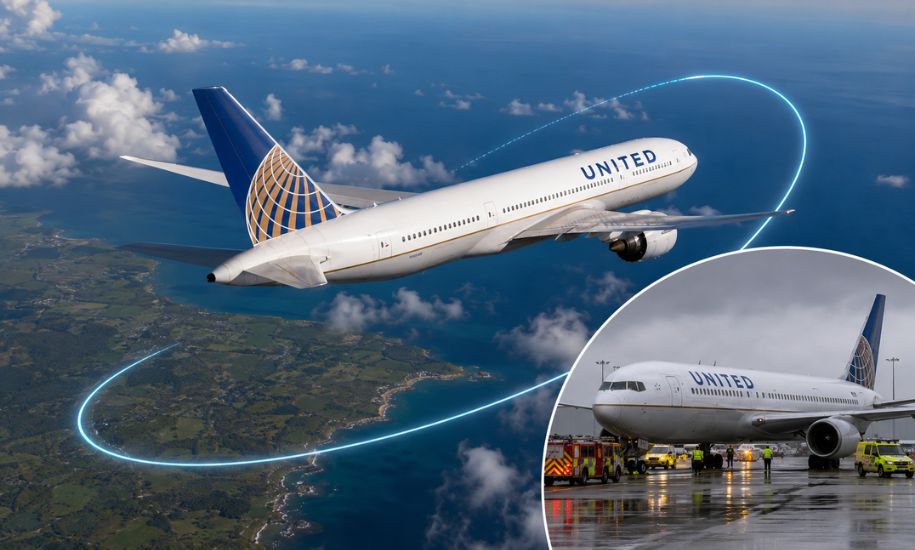
United Airlines Flight UA109 was scheduled to fly from Munich (MUC) to Washington Dulles (IAD) on October 30, 2025. Instead, the Boeing 787-8 turned around over the North Atlantic and diverted to Dublin Airport (DUB) before continuing to Washington later that day.
The unusual flight path quickly attracted attention because UA109 had already left Europe and was heading west across the Atlantic when it reversed course. Flight-tracking data showed the aircraft heading back toward Ireland, raising obvious questions: Why did UA109 divert? Was there a problem with the Boeing 787? Was someone sick onboard? And why was Dublin selected?
The most important update is that the reason should be described cautiously. A contemporaneous flight-disruption report listed the diversion as being caused by crew scheduling, while several later secondary articles described a medical problem involving a cabin crew member. The latter explanation has been repeated widely online, but the publicly available evidence does not justify presenting the more specific “painful blister” story as an officially confirmed fact.
What is much clearer is the operational sequence: UA109 diverted safely to Dublin, spent time on the ground, and subsequently continued to Washington. Contemporary tracking information also identifies the aircraft as Boeing 787-8 N28912.
United Flight UA109 at a Glance
| Detail | Information |
|---|---|
| Airline | United Airlines |
| Flight | UA109 |
| Origin | Munich Airport (MUC) |
| Scheduled destination | Washington Dulles (IAD) |
| Diversion airport | Dublin Airport (DUB) |
| Incident date | October 30, 2025 |
| Aircraft type | Boeing 787-8 Dreamliner |
| Reported registration | N28912 |
| Diversion reason | Reported as crew scheduling in contemporaneous flight-disruption reporting; later reports describe a crew medical issue |
| Outcome | Safe landing in Dublin followed by continuation toward Washington |
The aircraft identification and Dublin diversion are supported by contemporaneous tracking coverage. AIRLIVE reported that UA109 departed Munich, turned back over the Atlantic and was expected into Dublin at about 3:09 p.m.; its update recorded the aircraft landing on runway 10L.
What Happened to United Flight UA109?
UA109 began its journey normally from Munich, heading west toward Washington Dulles.
During the transatlantic portion of the flight, the aircraft changed course and turned back toward Ireland. Rather than continuing across the Atlantic, the Boeing 787-8 proceeded to Dublin Airport.
The diversion itself is well documented. Contemporary tracking coverage showed the aircraft’s U-turn and subsequent arrival at Dublin.
The reason for the diversion is where the available accounts diverge.
A contemporaneous October 30 entry in a consolidated United flight-disruption report states:
UA109 MUC-IAD 788 diverted to DUB due to crew scheduling.
That report also records the flight as arriving at IAD later than scheduled.
However, several articles published afterward attributed the event to a medical issue involving a cabin crew member. Some went further and claimed the issue involved severe pain from a blister.
Because those details are not supported by an equally strong primary or contemporaneous source in the material available, they should be treated as reported explanations rather than established facts.
Was UA109 Diverted Because of a Medical Emergency?
This is the question that requires the most careful wording.
Several later reports say that a cabin crew member developed a medical problem during the flight and that the condition affected the crew member’s ability to continue working. Some identify the problem specifically as a painful blister.
But another contemporaneous record identifies the reason simply as crew scheduling.
That difference matters.
It would be inaccurate to write that United officially confirmed a blister-related medical emergency unless a reliable primary statement establishing that fact can be produced.
The safest description is therefore:
UA109 diverted to Dublin after a crew-related operational issue; later secondary reports described the issue as a medical problem involving a cabin crew member, but the specific medical explanation is not independently confirmed by the strongest contemporaneous evidence available.
This distinction makes the article more trustworthy and avoids turning an internet explanation into a confirmed aviation fact.
Was There a Problem With the Boeing 787?
There is no strong evidence in the available reporting that a major mechanical failure caused the UA109 diversion.
Contemporary tracking coverage identified the aircraft as a Boeing 787-8 with registration N28912 and documented its turn toward Dublin. It did not report an engine failure, fire or major aircraft-system emergency as the reason for the diversion.
That does not prove that every aircraft system was perfect at every moment. It simply means there is no reliable evidence in the sources reviewed that a major technical failure was the trigger.
That distinction is useful when interpreting flight-tracking events. A U-turn over the Atlantic can look dramatic without necessarily indicating an aircraft emergency.
Why Did UA109 Choose Dublin?
Dublin is a logical airport for a transatlantic diversion because of its location and its ability to handle widebody international aircraft.
The airport is positioned close to major North Atlantic routes linking Europe with North America. A flight already heading west from continental Europe can reach Ireland without having to continue deep into the Atlantic.
For an aircraft requiring an unexpected landing, the decision involves much more than simple distance.
The flight crew and airline operations teams can consider factors such as:
- Aircraft position
- Remaining fuel
- Runway suitability
- Weather
- Airport operating conditions
- Emergency services
- Ground handling
- Maintenance support
- Passenger processing
- Crew requirements
- The nature of the operational problem
Dublin’s location makes it a practical option for many transatlantic flights that need to return toward Europe.
What Does the U-Turn Tell Us?
The visible U-turn is probably the most striking part of the incident.
AIRLIVE reported that UA109 had departed Munich at 12:14 CET according to its tracking report and then turned around over the Atlantic while cruising at approximately 40,000 feet. The same report later recorded the aircraft landing at Dublin.
From a passenger’s perspective, such a maneuver can look alarming.
From an operational perspective, however, turning around is exactly what an aircraft may do when the captain determines that continuing the original route is no longer the best option.
The important point is that flight tracking shows what the aircraft did, not necessarily why it did it.
That is why early online theories about mechanical failures, medical emergencies or security issues should be treated carefully until supported by reliable information.
Why a Crew Issue Can Affect a Long-Haul Flight
The cabin crew are not simply there to serve meals and assist passengers.
They have safety responsibilities that become particularly important during emergencies. Their duties can include:
- Managing an evacuation
- Responding to fire or smoke
- Operating emergency equipment
- Assisting passengers during abnormal situations
- Providing first aid
- Maintaining cabin security
- Communicating with the flight deck
For that reason, crew availability and fitness can become an operational consideration during a long-haul flight.
If the diversion was indeed connected to a crew medical or staffing issue, the relevant concern would not necessarily have been whether the aircraft could physically continue flying. The question would be whether the flight could continue while maintaining the required operational and safety conditions.
This is also why the phrase “crew scheduling” should not automatically be interpreted as a routine paperwork problem. Airline crew scheduling can involve duty-time limitations, staffing requirements and the availability of qualified crew.
Was UA109 an Emergency Landing?
The word “emergency” is often used loosely online.
A diversion and an emergency landing are not necessarily the same thing.
A diversion means that an aircraft changes its planned destination and lands somewhere else. The underlying reason can range from a passenger illness to weather, technical concerns, operational problems or crew-related issues.
The available evidence for UA109 establishes that the aircraft diverted to Dublin and landed safely. It does not establish that the aircraft was in a catastrophic emergency.
That distinction is particularly important when reading dramatic social-media descriptions of flight diversions.
What Happened After UA109 Reached Dublin?
The aircraft landed at Dublin rather than continuing toward Washington.
Contemporary tracking coverage reported the aircraft’s arrival and indicated that a new departure from Dublin was being scheduled for later that afternoon.
A later flight-disruption record states that UA109 eventually reached IAD 3 hours and 39 minutes late.
That figure is worth using instead of the “approximately two hours” claim in the original article because it comes from a contemporaneous operational record.
The exact ground process is less well documented publicly. Depending on the cause of a diversion, an airline may need to arrange fuel, ground handling, crew solutions, medical assistance, maintenance checks or other operational support before the aircraft can depart again.
Updated UA109 Timeline
Because different secondary sources give conflicting times and explanations, the timeline should be kept to events that can be supported.
October 30, 2025
Departure from Munich:
UA109 departed Munich Airport for its scheduled Washington Dulles service.
Atlantic crossing:
The Boeing 787-8 proceeded west before changing course and turning back toward Ireland.
Diversion to Dublin:
The aircraft diverted to Dublin Airport. Contemporary tracking coverage identified the aircraft as N28912 and reported its expected arrival at approximately 3:09 p.m. local time.
Landing in Dublin:
AIRLIVE subsequently reported that the aircraft had landed on runway 10L and was met by emergency vehicles.
Later continuation:
The aircraft subsequently continued its journey toward Washington.
Final delay:
A contemporaneous flight-disruption record reported that UA109 arrived at IAD 3 hours and 39 minutes late.
Why the Exact Reason Matters
The biggest weakness in many online articles about UA109 is that they turn an uncertain explanation into a definite statement.
For example, saying:
“United confirmed the diversion was caused by a blister.”
would require direct evidence from United or another authoritative source.
The available material does not support that level of certainty.
A more responsible formulation is:
“Contemporaneous reporting listed crew scheduling as the reason for the diversion, while several later reports attributed it to a medical issue involving a cabin crew member.”
That wording preserves both pieces of information without pretending they have equal evidentiary weight.
This is especially important for aviation articles because a small difference in wording can turn a plausible explanation into misinformation.
Did Weather Cause the Diversion?
There is no reliable indication in the sources reviewed that severe weather was responsible for UA109’s diversion.
The aircraft’s route change was instead associated with a crew-related operational issue in contemporaneous reporting.
That makes weather an unlikely explanation based on the currently available evidence.
Still, “not reported as weather-related” is more accurate than claiming that weather played absolutely no role in the operational decision unless an airline or airport statement confirms it.
Was the Diversion Caused by a Mechanical Failure?
Again, the available evidence does not point to a major mechanical failure.
The aircraft was tracked into Dublin and later continued toward Washington. Contemporary coverage identified the aircraft as the Boeing 787-8 N28912 but did not report an engine or major systems failure.
If a major mechanical emergency had been confirmed, that would materially change the interpretation of the event.
At present, the stronger evidence points toward a crew-related operational issue, not an aircraft failure.
What Passengers Can Learn From the UA109 Diversion
For travelers, the incident offers several useful lessons.
A flight tracker cannot tell you the whole story
Flight-tracking services are excellent for seeing an aircraft’s position, heading and destination changes.
They are not necessarily authoritative sources for the cause of a diversion.
A diversion does not automatically mean catastrophe
Airlines divert aircraft precisely because landing at another suitable airport can be the safest and most practical solution.
Crew issues can be operationally significant
A long-haul flight depends on more than engines and navigation systems. Crew availability and operational requirements are also part of the safety equation.
Keep important items in your cabin bag
On any long flight, it is sensible to keep essential medication, identification, valuables, chargers and other necessities accessible rather than placing them in checked luggage.
An unexpected diversion can turn a normal journey into a much longer airport experience.
What Is ETOPS and Does It Explain the Dublin Stop?
ETOPS, broadly speaking, is the regulatory and operational framework that allows appropriately approved twin-engine aircraft to operate routes that take them far from suitable airports.
It is particularly relevant to long-distance flights across oceans.
However, it would be an oversimplification to say that ETOPS rules automatically caused UA109 to divert to Dublin.
ETOPS planning helps determine how transatlantic flights are planned and what suitable alternates are available. The actual decision to divert depends on the circumstances of the flight, aircraft position, fuel, weather, airport conditions and the nature of the problem.
Dublin’s location makes it an important option for flights operating between Europe and North America, but the choice of diversion airport is an operational decision rather than a simple ETOPS formula.
What We Know vs. What Remains Uncertain
This is the clearest way to understand the incident.
Well-supported facts
- UA109 was operating from Munich to Washington Dulles.
- The aircraft was a Boeing 787-8.
- The reported registration was N28912.
- The flight diverted to Dublin on October 30, 2025.
- Contemporary tracking coverage documented the U-turn and Dublin landing.
- The aircraft later continued toward Washington.
- A contemporaneous flight-disruption report recorded the reason as crew scheduling.
- The same report recorded the flight arriving at IAD 3 hours and 39 minutes late.
Reported but less firmly established
Several later publications say the diversion resulted from a medical problem involving a cabin crew member. Some go further and identify a painful blister as the specific condition.
Those details should therefore be described as secondary reporting, not as an officially confirmed diagnosis.
Not established by the available evidence
There is no strong evidence in the sources reviewed that UA109 diverted because of:
- An engine failure
- A major mechanical malfunction
- A security threat
- A crash
- Severe weather
That does not mean every possible cause can be ruled out absolutely; it means those explanations are not supported by the strongest evidence reviewed for this article.
Why the UA109 Diversion Became a Talking Point
The incident was especially noticeable because of the aircraft’s position over the North Atlantic.
A flight from Munich to Washington is expected to keep moving west. When tracking data suddenly shows the aircraft reversing direction and returning toward Ireland, it naturally attracts attention.
That is how many aviation stories begin today: not with an official announcement, but with someone noticing an unusual line on a flight-tracking map.
The challenge is that the explanation often comes later.
In UA109’s case, the difference between “crew scheduling” in contemporaneous reporting and the later “medical/blister” explanation is a good example of why aviation reporting needs careful source checking.
Final Thoughts
The United Flight UA109 diversion on October 30, 2025 was a real and unusual transatlantic disruption: a Munich-to-Washington Boeing 787-8 turned around over the Atlantic and landed at Dublin before eventually continuing to Washington.
The aircraft, identified in contemporary coverage as N28912, landed safely at Dublin, and the flight later resumed its journey.
The main point that needs correcting in many versions of this story is the cause. A contemporaneous flight-disruption record lists crew scheduling as the reason, while later articles describe a cabin crew medical issue and, in some cases, a specific blister.
Until a stronger primary source establishes the precise cause, the responsible conclusion is that UA109 experienced a crew-related operational disruption that led to a diversion to Dublin.
That version is both more accurate and more useful to readers. It explains what is known, identifies what remains uncertain, and avoids presenting an unverified detail as fact.
Frequently Asked Questions
Why did United Flight UA109 divert to Dublin?
Contemporaneous flight-disruption reporting listed crew scheduling as the reason UA109 diverted from its Munich–Washington route to Dublin. Several later reports instead described a medical issue involving a cabin crew member, but the more specific medical explanation is not as firmly established in the available evidence.
Was United Flight UA109 experiencing a mechanical problem?
There is no strong evidence in the sources reviewed that a major mechanical failure caused the diversion. Contemporary tracking coverage identified the Boeing 787-8 and documented its safe landing at Dublin without reporting an engine or major aircraft-system emergency.
Why did UA109 turn around over the Atlantic?
The aircraft changed course after the flight encountered a crew-related operational issue. Rather than continuing the transatlantic crossing, the crew diverted toward Ireland and landed at Dublin, where the aircraft could be handled before continuing its journey.
Did United Flight UA109 continue to Washington?
Yes. The flight did not terminate permanently in Dublin. The available operational record indicates that UA109 later reached Washington Dulles, with the flight recorded as arriving 3 hours and 39 minutes late.
Was the UA109 diversion caused by a cabin crew medical emergency?
That explanation appears in multiple later reports, some of which claim the medical issue involved a painful blister. However, a contemporaneous flight-disruption record described the reason as crew scheduling, so the medical explanation should currently be presented as reported rather than definitively confirmed.
Was Dublin an emergency landing?
UA109 did divert and land at Dublin, but the available evidence does not indicate a catastrophic aircraft emergency. The safest description is that it was an unscheduled diversion to Dublin following a crew-related operational issue, after which the flight continued toward Washington.
