


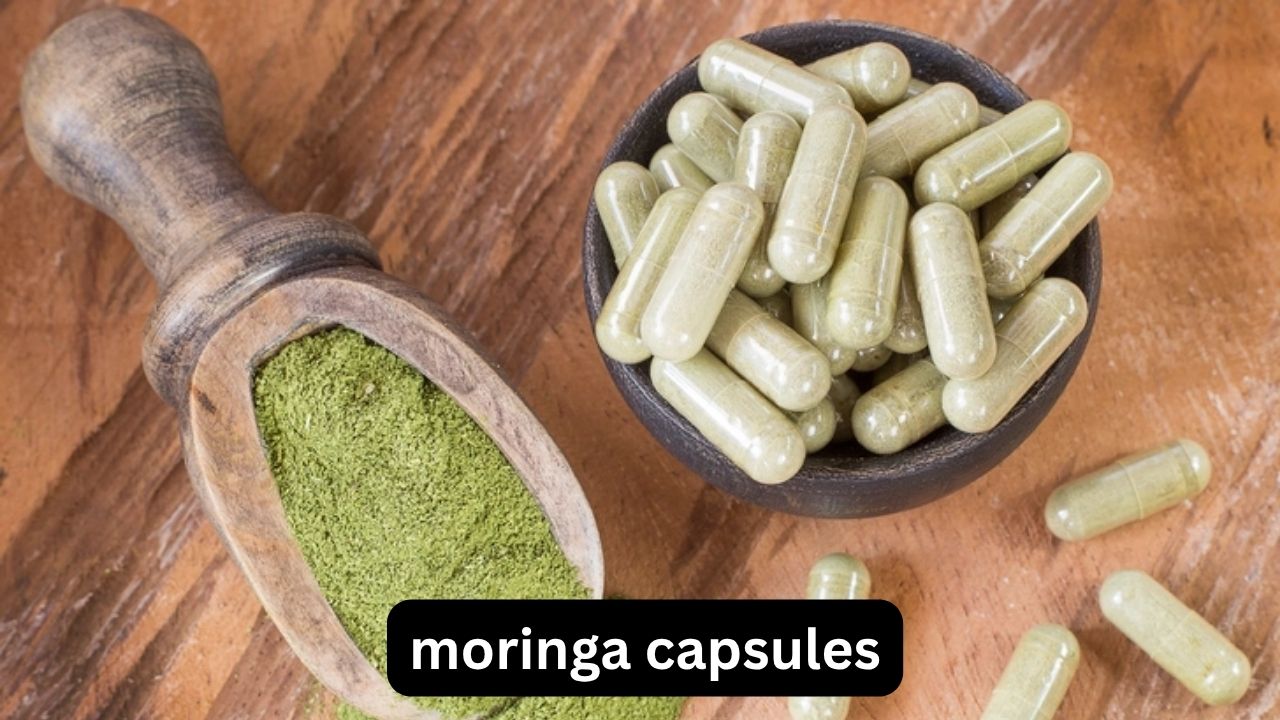
If you are considering moringa capsules because you want an easy way to add moringa to your daily routine, the first question is usually simple: Do they actually do anything? The answer is more nuanced than many supplement labels suggest.
Moringa oleifera leaves contain polyphenols and other plant compounds, as well as nutrients, and early human research has investigated their possible effects on blood sugar, blood pressure, nutrition and antioxidant status. However, the evidence is still developing, and moringa should not be treated as a cure or a replacement for prescribed treatment.
This guide explains what moringa capsules are good for, how to choose pure or organic moringa capsules in the UK, how dosage differs between products, what the research actually says, and which common supplement-buying mistakes are worth avoiding.
What are moringa capsules?
Moringa capsules are dietary supplements made from parts of the Moringa oleifera plant, most commonly dried leaf powder or a concentrated leaf extract.
The distinction matters because two bottles can both say “moringa capsules” while delivering very different amounts of the plant.
A label may contain:
- Moringa leaf powder
- Moringa leaf extract
- A concentrated extract with a stated ratio, such as 10:1 or 50:1
- Moringa seed extract
- A mixture of several plant ingredients
For everyday nutritional use, leaf powder and leaf extract should not automatically be considered equivalent. An extract can be much more concentrated than ordinary dried leaf, so comparing products purely by the number of milligrams on the front of the bottle can be misleading.
What is moringa good for?
Moringa is best thought of as a nutrient-containing plant supplement, rather than a medicine for a particular disease.
Research has investigated possible benefits involving:
- Antioxidant activity
- Blood-glucose regulation
- Blood pressure
- Blood lipids
- General nutritional status
- Some markers of inflammation and metabolic health
The important qualification is that human studies remain relatively limited and use different preparations and doses. A 2026 systematic review found promising effects on blood glucose and blood pressure in people with metabolic disorders, but the researchers described the evidence as preliminary because of differences in study quality and design.
Moringa capsules benefits: what does the evidence show?
1. They provide concentrated plant compounds
Moringa leaves contain polyphenols, flavonoids, glucosinolates and other bioactive compounds. These substances are one reason moringa has attracted scientific interest.
Laboratory research can demonstrate antioxidant or biological activity, but that does not automatically mean taking a capsule will produce the same effect in a person.
This distinction is particularly important when reading supplement marketing.
2. Blood sugar is one of the most researched areas
Moringa has received considerable attention for possible effects on glucose metabolism.
The results, however, are mixed.
One randomized placebo-controlled trial gave people with type 2 diabetes 8 g of moringa leaf capsules daily for four weeks. It found no significant improvement in fasting glucose or HbA1c, although the supplement was generally well tolerated.
Other studies have reported potentially beneficial changes. A newer 2026 review of clinical studies found an overall association between moringa supplementation and lower fasting glucose and HbA1c, but emphasized substantial variation between studies and the need for better trials.
Practical takeaway: moringa may be interesting for metabolic health, but it should not replace diabetes medication, dietary treatment or glucose monitoring.
3. Blood pressure may be affected
Blood pressure is another area where the evidence is promising but not definitive.
Some clinical studies have observed reductions in blood pressure. A 2026 meta-analysis specifically examining body weight and blood pressure concluded that there was still insufficient evidence to establish a clear causal relationship between moringa and reductions in blood pressure or body measurements.
That makes moringa a poor choice as a substitute for prescribed blood-pressure treatment.
4. Moringa may contribute to nutritional intake
Moringa leaves are nutrient-dense, which is different from saying that capsules are a complete multivitamin.
Research into moringa supplementation has found potential nutritional benefits in certain populations, including studies involving haemoglobin and vitamin A status. However, the evidence is limited and the benefits depend heavily on the population, preparation and dose used.
For someone with an otherwise balanced diet, a moringa capsule should be viewed as an optional supplement, not a replacement for vegetables, legumes, fruit or other nutrient-rich foods.
Pure moringa capsules vs moringa extract
This is one of the most useful distinctions when comparing products.
Pure moringa leaf powder generally means the dried leaf has been ground into powder and placed into capsules.
Moringa extract means compounds have been extracted from the plant and concentrated.
Neither is automatically “better.”
If your goal is simply adding moringa leaf to your diet, a straightforward leaf-powder product may be easier to understand. If you choose an extract, pay closer attention to the extraction ratio and the actual amount supplied.
A label saying “400 mg moringa” may sound impressive, but 400 mg of a concentrated extract is not necessarily comparable with 400 mg of ordinary leaf powder.
A surprisingly important detail: the plant part
Another overlooked issue is which part of moringa is used.
Leaf products have been studied substantially more than many other preparations in human nutrition research. Moringa seeds, roots, bark and other plant parts have different chemical profiles.
So when comparing products, don’t stop at the word “moringa.” Look for the specific plant part.
How to choose organic moringa capsules in the UK
If you’re searching for organic moringa capsules UK, “organic” can be a useful purchasing criterion, but it shouldn’t be your only one.
Look for a product that clearly states:
- Moringa species — preferably Moringa oleifera.
- Plant part — ideally clearly identified rather than simply “moringa.”
- Amount per serving — not just the amount per bottle.
- Powder or extract — this affects how you interpret the dose.
- Other ingredients — useful if you want a simple product.
- Batch or quality information — helpful for traceability.
- Suggested serving — compare this with competing products.
The word “organic” does not mean a supplement is clinically proven to work. It describes how the ingredient is produced under the relevant certification system; it does not establish that a particular dose has a medical benefit.
What about Rosabella moringa capsules?
People specifically searching for Rosabella moringa capsules benefits should apply the same principle used for any branded supplement: examine the actual label rather than assuming the brand name tells you the strength or effectiveness.
Check:
- Moringa amount per capsule
- Recommended daily serving
- Whether it is leaf powder or extract
- Additional ingredients
- Organic certification, if claimed
- Manufacturer and batch information
The expected benefits should not be assumed simply because a product is marketed as “pure,” “natural” or “premium.” The evidence for moringa generally cannot automatically be transferred to every formulation sold under a particular brand.
What about moringa capsules from Holland & Barrett?
If you’re considering moringa capsules from Holland & Barrett, compare the product’s formulation rather than choosing it solely because of the retailer.
Two useful questions are:
How much moringa do I actually get per daily serving?
and
Is it leaf powder or a concentrated extract?
Those answers make comparisons much more meaningful than capsule count.
A bottle containing 120 low-dose capsules may provide less moringa per day than a 60-capsule bottle with a higher-strength serving.
Moringa capsules dosage per day: how much should you take?
There is no single universally established daily dose of moringa capsules for healthy adults.
This is an important point because research studies have used widely different preparations and doses.
For example, human trials have investigated doses ranging from relatively small amounts to several grams of leaf powder per day. One trial used 8 g daily, while another study in healthy volunteers investigated escalating doses up to 4 g.
That does not mean you should automatically take 4–8 g yourself.
A supplement label may recommend a much smaller serving because the product could contain a concentrated extract.
A sensible approach
If you’re new to moringa:
- Read the manufacturer’s recommended serving.
- Identify whether the product contains powder or extract.
- Don’t exceed the stated dose.
- Take it consistently rather than repeatedly increasing the amount.
- Stop if you develop troublesome symptoms.
One NIH dietary-supplement label, for example, lists a 400 mg serving of moringa leaf and seed extract and recommends two capsules twice daily. That illustrates why product labels can vary considerably; it should not be interpreted as a universal moringa dosage.
When should you take moringa capsules?
There is no strong evidence that a particular time of day makes moringa dramatically more effective.
For practical reasons, many people prefer taking capsules with a meal and water, especially if supplements tend to upset their stomach when taken on an empty stomach.
Consistency is usually more useful than obsessing over whether morning or evening is “best.”
If you’re taking medication for blood sugar or blood pressure, however, don’t use timing tricks to try to enhance moringa’s effects without discussing it with a healthcare professional.
Possible side effects and safety
Moringa has generally been well tolerated in several human studies, but “natural” does not mean “risk-free.”
Possible problems can include:
- Digestive upset
- Diarrhoea
- Nausea
- Abdominal discomfort
- Allergic reactions in susceptible people
A recent review of human studies described moringa as generally well tolerated but noted rare adverse reports and emphasized the need for better long-term safety data.
There is also an important difference between short-term research safety and proven long-term safety. Many clinical studies are relatively small or short, so there is less certainty about prolonged high-dose supplementation.
Who should be particularly cautious?
Speak with a healthcare professional before using moringa if you:
- Take diabetes medication
- Take blood-pressure medication
- Take multiple prescription medicines
- Are pregnant or breastfeeding
- Have a significant medical condition
- Are considering a high-dose extract
This is especially important because moringa may influence biological pathways involved in blood glucose and blood pressure.
Three less obvious things to know about moringa capsules
1. “More milligrams” can actually make comparisons harder
A 2,000 mg leaf-powder serving and a 400 mg concentrated extract cannot be judged simply by the numbers.
The extraction process changes what those milligrams represent. This is one reason experienced supplement buyers compare ingredient form, standardization and serving instructions, rather than chasing the largest number on the label.
2. A capsule can hide a very different research dose
Suppose a study used 8 g of whole leaf powder, while your capsule contains 500 mg.
You would need many capsules to reproduce the study’s raw powder amount—but doing so may be inappropriate if your product is an extract.
In other words, research dose ≠ automatically recommended consumer dose.
This is a common mistake when people search for “moringa capsules dosage per day.”
3. The food-versus-medicine distinction matters
Moringa has nutritional value and promising biological properties, but the strongest claims often come from laboratory, animal or small human studies.
That means “contains antioxidant compounds” is a much safer statement than “prevents disease.”
This distinction helps you get genuine value from a supplement without expecting it to do something the evidence has not established.
Common mistakes when buying moringa capsules
Choosing the cheapest bottle
Price per bottle tells you very little.
Instead, calculate the approximate cost per daily serving and compare the amount and form of moringa.
Assuming organic means more effective
Organic production and clinical effectiveness are different questions.
An organic supplement can still have a poorly disclosed dose or an unsuitable formulation.
Taking several supplements with similar purposes
If you’re already using a multivitamin, herbal blend or other metabolic-health supplement, adding moringa without checking the ingredients can create unnecessary duplication.
Increasing the dose because you don’t “feel” anything
Moringa isn’t a stimulant that necessarily produces an obvious sensation.
Increasing the dose simply because you don’t notice an immediate effect is not a sound approach.
Are moringa capsules worth taking?
For a healthy adult who wants to add moringa to their diet, a reputable, clearly labelled product can be a reasonable optional nutritional supplement.
The strongest argument for moringa is not that it is a miracle ingredient. It is that the leaves contain useful plant compounds and nutrients, while early human research gives researchers legitimate reasons to investigate possible metabolic and nutritional effects further.
The evidence is much less convincing for treating a specific medical condition.
If your main goal is blood sugar, blood pressure, weight loss or another health problem, treat moringa as something that may complement—not replace—evidence-based care.
FAQ
What are moringa capsules good for?
Moringa capsules provide compounds and nutrients derived from Moringa oleifera, particularly when made from the leaves. Research has investigated possible effects on antioxidant status, blood glucose, blood pressure and nutritional health. Human evidence is promising in some areas but remains insufficient to consider moringa a treatment for disease.
How many moringa capsules should I take per day?
There is no universal dose because products differ substantially in concentration and formulation. Follow the specific product’s serving instructions rather than copying the dose from a clinical study. Research has used doses ranging from hundreds of milligrams of extracts to several grams of leaf powder, which demonstrates why direct comparisons can be misleading.
Are organic moringa capsules better?
Organic certification can be useful if you specifically want organically produced ingredients, but it does not prove that the product is more effective. Check the amount of moringa, plant part, powder-versus-extract formulation and quality information as well. Effectiveness depends on the formulation and evidence, not the word “organic” alone.
What are the benefits of pure moringa capsules?
Pure moringa capsules can offer a simpler formulation when the ingredient is clearly identified as Moringa oleifera leaf powder or extract. This makes it easier to understand what you are taking and compare products. However, “pure” does not automatically mean clinically superior, and the health effects still depend on dose and formulation.
Can you take moringa capsules every day?
Many people use moringa products daily according to the manufacturer’s directions, and short-term human studies have generally reported good tolerability. However, long-term high-dose safety is less well established than supplement marketing sometimes implies. If you take medication or have a medical condition, discuss regular use with a healthcare professional.
Can moringa capsules help with blood sugar?
Possibly, but the evidence is not consistent enough to treat moringa as a diabetes medicine. Some recent analyses suggest potentially beneficial effects, while controlled trials have also found no significant improvement in glucose control.
Conclusion
Moringa capsules can be a convenient way to consume Moringa oleifera, particularly when you don’t want to use powdered leaves in food. The plant has genuine nutritional and biological interest, and current research suggests possible benefits involving metabolic and nutritional health.
But the smartest approach is to look beyond the marketing.
Choose a clearly labelled product, distinguish leaf powder from concentrated extract, check the actual daily serving, and don’t assume that “organic,” “pure” or a higher milligram number automatically means better results.
Most importantly, use moringa as a supplement—not as a replacement for proven medical treatment. The evidence is interesting enough to take seriously, but not strong enough to justify the miracle claims sometimes attached to it.
